Food and Flame in the Sudanese Maseed

Food and Flame in the Sudanese Maseed
Where Bread and Dhikr Meet
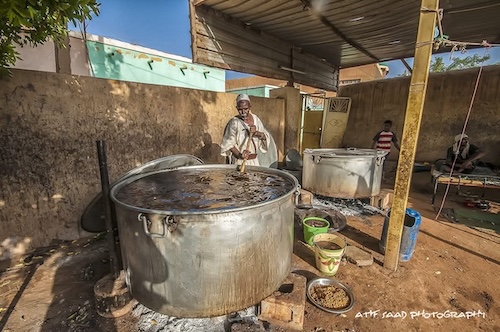
At the masid (a religious school and communal space) of Sheikh Wad Badr in Um Dawanban, a tale has been passed down through generations telling of Sheikh al-Obeid Wad Badr and the dibliba. This refers to the staple lump of dough, also known as ‘asida, that is made of sorghum and that has been known for over 170 years. The tale relates to the miracle of how the fire where the dibliba is cooked has never died out, and how the flour to make it has never run out. This remarkable feature of the masid is similar to the way Sudanese takaya (communal kitchens) continue to function. At the masid, the ‘asida is continuously being cooked over the fire and is stirred in a circular motion that echoes the endless chants of dhikr (supplications of God’s names) that reverberate around the courtyard.
Fire is therefore a deeply rooted symbol of Sudanese heritage for both providing food and sustenance, and for the light of the Qur’an and the guidance it provides. Those lighting a fire at night are celebrated for their generosity and hospitality, as in the popular song: ‘Your fire burns till dawn, O ever present Sheikh Wad Badr.’ Fire also represents knowledge in some religious verses:
‘Where is Dishayn, the judge of justice,
Who does not stray from the path of the righteous.
He of pure descent, who kindled the flame of the Message (of Islam).’
Sheikh Al-Obeid Wad Badr himself first settled in Al-Nikhayra, east of Um Dawanban, where he lit the fire known as tuqqāba to teach the Qur’an and honour guests with ‘asida. In Sudan, a tuqqāba refers to an area dedicated to learning the Qur’an, usually located next to, or forming part of, the masid. These were places where students resided, receiving both spiritual and material care. At the time, Sheikh Wad Badr acquired the nickname ‘Awaj al-Darib’ meaning ‘the one who diverted the path’ because he would spend the rainy season in Al-Nikhayra cultivating sorghum, and then in the summer, he would move to Um Dawanban where he eventually settled and founded the masid that would later flourish.
The ‘asida that has been cooked at the masid since those early days, became known as the dibliba. After the sorghum was ground and prepared, it was cooked on a large iron griddle or sāj, then it was divided with a wooden blade into equal portions and served in carved wooden bowls with yoghurt or beans. People would come to eat the dibliba but to also receive the blessings of the ritual.
Sheikh Wad Badr often linked food with the spiritual, urging his disciples to feed others as a way to bring them closer to the divine; ‘Give a morsel, measure your words, do not be stern, and before daybreak rise to see if anyone is hungry’ was one of his sayings. ‘Give money, spread the seating mat, feed the hungry and see how people will gather around you,’ was another. Yet another went ‘whoever has no love, has nothing,’ and ‘blessed is the one who performs his night prayer and shares his supper and who rises before dawn to offer a humble prayer to his Lord.’
The dibliba, or ‘asida, is known by different names in other masid. For example al-muhayba or Allahallah and is used to describe the food of the murīdīn (devotees, Qur’an scholars, disciples and ascetics). While this staple food is shunned by wealthy or arrogant people, in the eyes of the murīdīn it is blessed and provides source of healing, and is a humbling experience for the community. In devotional chants it is described as such:
‘The lalūba (Balanites aegyptiaca, whose wood is used to make the paddle and bowl receptacle and whose stones are threaded onto a sibha to form prayer beads and evokes spiritual endurance and nocturnal devotion.)
By night it’s servants chant.
The lalūba, O lalūba,
O what an honourable ritual,
Not only is it food, but a rite of love,
A balm for the soul, a quiet teacher of humility.
Those youth who seek it unveil the mystery, taste its fruit and drink from its hidden treasures.’

From the masid of Sheikh Wad Badr, the tale extends to other masids and khalāwī across Sudan, where these meanings are continually replicated with only minor differences. The masid is bound to the land and to farming: the sheikh and his students cultivate the adjoining fields planting sorghum, harvesting it, and storing it in the makhzan al-mīra (provisions storehouse). Each evening the sorghum is ground, and the Khalīfa himself oversees the food, from the emergence of raw materials from the storehouse, to the moment it is served. It is a never-ending daily cycle, a rhythm of labour, devotion, and care.
At the heart of Sudanese Sufi life, food is never separate from dhikr just as fire is accompanied by light. In one corner of the masid, verses of the Qur’an are recited, in another, the fire of the dibliba burns. It is a flame that glows beneath the pots of ‘asida, just as it glows within the hearts of the devotees. It sustains the ḥīrān (students and followers) body and soul alike. This fire burns throughout the year, as if in a never-ending prayer, and has become the defining emblem of Sheikh Wad Badr’s way of teaching the Qur’an and educating his students.
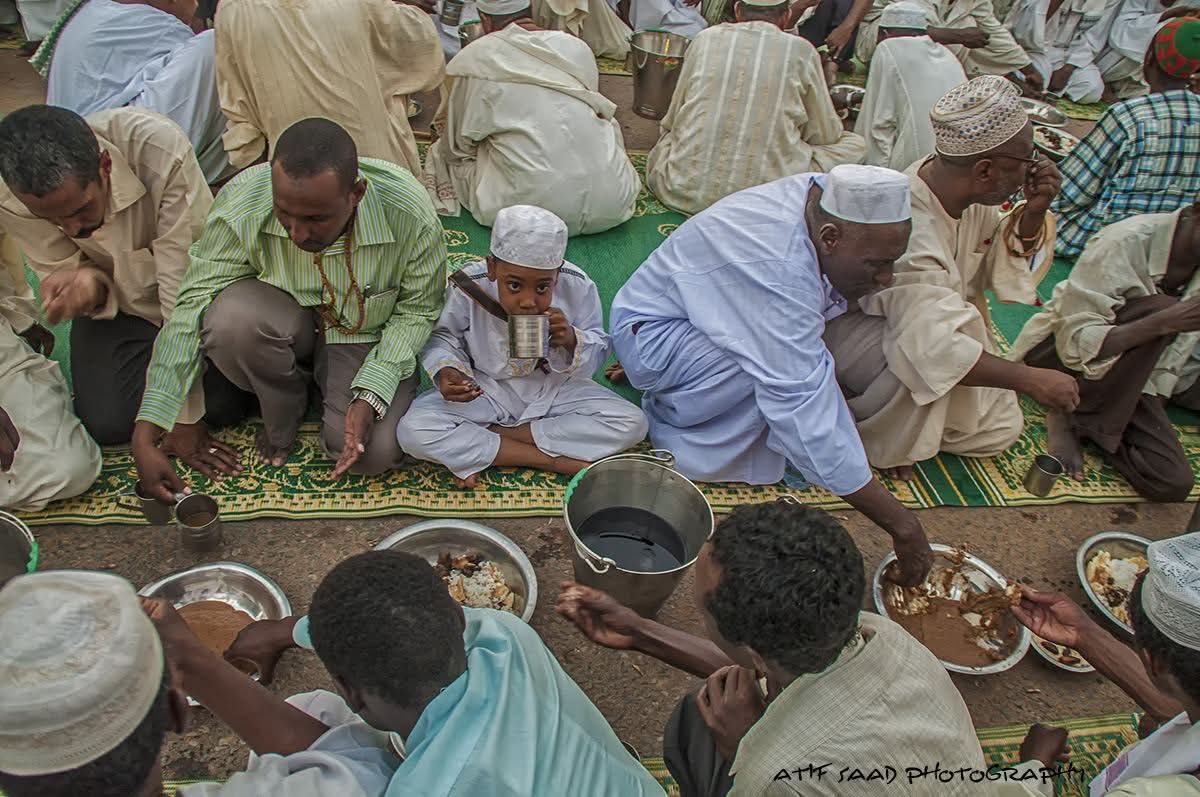
The fire of the masid not only illuminates the world around it, it creates an entire system of economic, spiritual, and social solidarity where the student is nourished by the yield of his own labour and the guest eats from the communal platter. The wealthy bestow karāma, or charitable offerings, upon the ḥīrān and grain is sometimes taken to homes in the village where it is cooked and returned to the masid, accompanied by prayers of blessing. These practices intersect with the ideals of communal protection and independence from the market, forming an enduring safety net even in times of crisis and war.
When Souls Are Nurtured by the Fire of Kisra
In the masid, a dedicated group of workers gathers firewood, flour, and food. The students themselves clear the rough ground, sow it with sorghum, and store the harvest. This crop serves as a vital support for the masid’s communal kitchen known as takiyya.
In the kitchen, a group of women both young and old, work with quiet intensity to prepare food for the students, as an act of devotion to get closer to God. Here, food is not a domestic chore but part of a collective pedagogy, where spiritual and practical values are nurtured together. The ḥīrān share these responsibilities according to how long they have been at the masid. Thus, newcomers gather firewood and clean pots, while the more advanced move on to ʿiwāsa (stirring the sorghum porridge), cooking ʿ’asida, and preparing drinks such as ḥilū mur and abray abyad.
The preparation of dibliba is an elaborate communal ritual and is a process that is repeated throughout the day, with the masid consuming between 10 and 30 sacks of flour daily to feed over 1,500 students and visitors.
Male students also contribute by building ovens, cleaning the food courtyards, and transporting meals in orderly rows in a display of discipline and cooperation. This collective system is called al-‘ammār, and has a daily schedule where duties are carefully divided out and food is not only sustenance, but a ritual practice, creating a sense of belonging and deepening ties between student and place, individual and community.
Women from the village and surrounding areas also contribute to food preparation—especially in the Bayt al-Ṭayyāb (House of Cooking), where fatta and ‘asida are prepared and tables are laid out for special occasions. The Khalīfa or Sheikh oversees the coordination between the groups, taking into account the age and rank of the members. Each movement to prepare the food is seen as part of the process of tazkiya or the purification of the soul. Every meal served is regarded as ṣadaqa jāriya an ongoing charity in the community’s shared ledger of good deeds.
When the Takiyya Is Lit in Times of War
In Sudan, the takiyya is not merely a place for preparing food, it is also a social and spiritual institution, deeply rooted in collective memory. Historically, it took form within the masids and khalāwī and was always associated with the rings of dhikr and Qur’anic teaching.
This fire of the masid has, over time, been transformed from its traditional representation into more flexible, responsive manifestations, especially in times of disaster. After the outbreak of war in Sudan in April 2023 and as supply chains collapsed and markets ground to a halt and the state fell into paralysis, emergency kitchens known as neighbourhood takiyya initiatives, emerged across many districts of the capital Khartoum, and its outskirts. They were collective, community-driven efforts to provide food for the displaced and affected residents.
These kitchens were established in diverse locations. Some emerged within the courtyards of old masids, where traditional spaces were revived such as the masid of Sheikh al-Yaqout and the masid of Abu Qurun. There, the old Bayt al-Ṭayyāb and granaries were repurposed to prepare food for the displaced. However, the vast majority of kitchens were established from scratch; two pots and a bundle of firewood built by neighbourhood women and youth from the resistance committees. They sprang up in public squares, inside schools transformed into shelters, and even within volunteers’ homes. In these kitchens, cooking was not merely a biological act but one of resistance, a preservation of dignity. Women and youth prepared food with the same intention that once animated the masid: the spirit of the collective, support of the vulnerable and feeding the hungry with dignity. As in the past, when the takiyya was rooted in the land sustained by fields and harvest seasons and guided by the spiritual leadership of the Sheikh, in times of war, the land changed, and the harvest disappeared but the spirit of the act remained.
Support now comes in the form of remittances from those abroad, in-kind donations, and digital campaigns of solidarity. Yet the fire still burns, and the intention lives on. Within the emergency kitchens, as in the old takiyyas, an elaborate system of labour division emerged and tasks were typically assigned according to capacity and availability. Women bore the main responsibility for cooking, while men managed the procurement of supplies from markets, fetched water, and secured gas or firewood at a time of extreme scarcity. Young people of all genders joined in distributing meals and organising queues.
These kitchens were not merely relief initiatives. They reimagined the principle of the takiyya in a contemporary context, where preparing food became a collective act—an expression of resilience. What was once a domestic task was transformed into a communal practice with long-standing rituals. Despite their simplicity, these kitchens were able to sustain a network of mutual support that withstood the collapse of markets and scarcity of resources and demonstrated that there was no need for bureaucratic structures. Trust and local knowledge were enough to organize the work just as it was in the masid, where much was accomplished with little, where fire became a sign of life, and cooking was a prayer to stave off hunger.
When Fire Becomes Prayer
In a country besieged by recurring crises, where war extinguishes light, the fire of the masid continues to burn not only as a form of miracle but as a sign of life. From the dibliba simmering in Sheikh Wad Badr’s courtyard to the pot of balīla beans in an emergency kitchen in a crumbling neighbourhood of Khartoum, the flame is passed on not only through firewood, but through what cannot be seen: intention, love, and certainty. The takiyya was never only a kitchen for distributing food, it was a space where dhikr met labour; where hunger was dissolved in the generosity of the collective. When the siege tightened and Khartoum burned, the takiyya returned to offer salvation. Emergency kitchens became a living extension of that legacy, where people gathered around the fire to eat and to preserve what remained of their humanity. Women’s kind act of lighting fires was carried in the bodies of all the followers and anyone came from the wilderness to seek its warm blessing. With every ladle of food, a memory was revived, that of a fire that never dies, and a spirit that is never broken.
Cover picture taken by Atif Saad
Where Bread and Dhikr Meet
At the masid (a religious school and communal space) of Sheikh Wad Badr in Um Dawanban, a tale has been passed down through generations telling of Sheikh al-Obeid Wad Badr and the dibliba. This refers to the staple lump of dough, also known as ‘asida, that is made of sorghum and that has been known for over 170 years. The tale relates to the miracle of how the fire where the dibliba is cooked has never died out, and how the flour to make it has never run out. This remarkable feature of the masid is similar to the way Sudanese takaya (communal kitchens) continue to function. At the masid, the ‘asida is continuously being cooked over the fire and is stirred in a circular motion that echoes the endless chants of dhikr (supplications of God’s names) that reverberate around the courtyard.
Fire is therefore a deeply rooted symbol of Sudanese heritage for both providing food and sustenance, and for the light of the Qur’an and the guidance it provides. Those lighting a fire at night are celebrated for their generosity and hospitality, as in the popular song: ‘Your fire burns till dawn, O ever present Sheikh Wad Badr.’ Fire also represents knowledge in some religious verses:
‘Where is Dishayn, the judge of justice,
Who does not stray from the path of the righteous.
He of pure descent, who kindled the flame of the Message (of Islam).’
Sheikh Al-Obeid Wad Badr himself first settled in Al-Nikhayra, east of Um Dawanban, where he lit the fire known as tuqqāba to teach the Qur’an and honour guests with ‘asida. In Sudan, a tuqqāba refers to an area dedicated to learning the Qur’an, usually located next to, or forming part of, the masid. These were places where students resided, receiving both spiritual and material care. At the time, Sheikh Wad Badr acquired the nickname ‘Awaj al-Darib’ meaning ‘the one who diverted the path’ because he would spend the rainy season in Al-Nikhayra cultivating sorghum, and then in the summer, he would move to Um Dawanban where he eventually settled and founded the masid that would later flourish.
The ‘asida that has been cooked at the masid since those early days, became known as the dibliba. After the sorghum was ground and prepared, it was cooked on a large iron griddle or sāj, then it was divided with a wooden blade into equal portions and served in carved wooden bowls with yoghurt or beans. People would come to eat the dibliba but to also receive the blessings of the ritual.
Sheikh Wad Badr often linked food with the spiritual, urging his disciples to feed others as a way to bring them closer to the divine; ‘Give a morsel, measure your words, do not be stern, and before daybreak rise to see if anyone is hungry’ was one of his sayings. ‘Give money, spread the seating mat, feed the hungry and see how people will gather around you,’ was another. Yet another went ‘whoever has no love, has nothing,’ and ‘blessed is the one who performs his night prayer and shares his supper and who rises before dawn to offer a humble prayer to his Lord.’
The dibliba, or ‘asida, is known by different names in other masid. For example al-muhayba or Allahallah and is used to describe the food of the murīdīn (devotees, Qur’an scholars, disciples and ascetics). While this staple food is shunned by wealthy or arrogant people, in the eyes of the murīdīn it is blessed and provides source of healing, and is a humbling experience for the community. In devotional chants it is described as such:
‘The lalūba (Balanites aegyptiaca, whose wood is used to make the paddle and bowl receptacle and whose stones are threaded onto a sibha to form prayer beads and evokes spiritual endurance and nocturnal devotion.)
By night it’s servants chant.
The lalūba, O lalūba,
O what an honourable ritual,
Not only is it food, but a rite of love,
A balm for the soul, a quiet teacher of humility.
Those youth who seek it unveil the mystery, taste its fruit and drink from its hidden treasures.’
From the masid of Sheikh Wad Badr, the tale extends to other masids and khalāwī across Sudan, where these meanings are continually replicated with only minor differences. The masid is bound to the land and to farming: the sheikh and his students cultivate the adjoining fields planting sorghum, harvesting it, and storing it in the makhzan al-mīra (provisions storehouse). Each evening the sorghum is ground, and the Khalīfa himself oversees the food, from the emergence of raw materials from the storehouse, to the moment it is served. It is a never-ending daily cycle, a rhythm of labour, devotion, and care.
At the heart of Sudanese Sufi life, food is never separate from dhikr just as fire is accompanied by light. In one corner of the masid, verses of the Qur’an are recited, in another, the fire of the dibliba burns. It is a flame that glows beneath the pots of ‘asida, just as it glows within the hearts of the devotees. It sustains the ḥīrān (students and followers) body and soul alike. This fire burns throughout the year, as if in a never-ending prayer, and has become the defining emblem of Sheikh Wad Badr’s way of teaching the Qur’an and educating his students.
The fire of the masid not only illuminates the world around it, it creates an entire system of economic, spiritual, and social solidarity where the student is nourished by the yield of his own labour and the guest eats from the communal platter. The wealthy bestow karāma, or charitable offerings, upon the ḥīrān and grain is sometimes taken to homes in the village where it is cooked and returned to the masid, accompanied by prayers of blessing. These practices intersect with the ideals of communal protection and independence from the market, forming an enduring safety net even in times of crisis and war.
When Souls Are Nurtured by the Fire of Kisra
In the masid, a dedicated group of workers gathers firewood, flour, and food. The students themselves clear the rough ground, sow it with sorghum, and store the harvest. This crop serves as a vital support for the masid’s communal kitchen known as takiyya.
In the kitchen, a group of women both young and old, work with quiet intensity to prepare food for the students, as an act of devotion to get closer to God. Here, food is not a domestic chore but part of a collective pedagogy, where spiritual and practical values are nurtured together. The ḥīrān share these responsibilities according to how long they have been at the masid. Thus, newcomers gather firewood and clean pots, while the more advanced move on to ʿiwāsa (stirring the sorghum porridge), cooking ʿ’asida, and preparing drinks such as ḥilū mur and abray abyad.
The preparation of dibliba is an elaborate communal ritual and is a process that is repeated throughout the day, with the masid consuming between 10 and 30 sacks of flour daily to feed over 1,500 students and visitors.
Male students also contribute by building ovens, cleaning the food courtyards, and transporting meals in orderly rows in a display of discipline and cooperation. This collective system is called al-‘ammār, and has a daily schedule where duties are carefully divided out and food is not only sustenance, but a ritual practice, creating a sense of belonging and deepening ties between student and place, individual and community.
Women from the village and surrounding areas also contribute to food preparation—especially in the Bayt al-Ṭayyāb (House of Cooking), where fatta and ‘asida are prepared and tables are laid out for special occasions. The Khalīfa or Sheikh oversees the coordination between the groups, taking into account the age and rank of the members. Each movement to prepare the food is seen as part of the process of tazkiya or the purification of the soul. Every meal served is regarded as ṣadaqa jāriya an ongoing charity in the community’s shared ledger of good deeds.
When the Takiyya Is Lit in Times of War
In Sudan, the takiyya is not merely a place for preparing food, it is also a social and spiritual institution, deeply rooted in collective memory. Historically, it took form within the masids and khalāwī and was always associated with the rings of dhikr and Qur’anic teaching.
This fire of the masid has, over time, been transformed from its traditional representation into more flexible, responsive manifestations, especially in times of disaster. After the outbreak of war in Sudan in April 2023 and as supply chains collapsed and markets ground to a halt and the state fell into paralysis, emergency kitchens known as neighbourhood takiyya initiatives, emerged across many districts of the capital Khartoum, and its outskirts. They were collective, community-driven efforts to provide food for the displaced and affected residents.
These kitchens were established in diverse locations. Some emerged within the courtyards of old masids, where traditional spaces were revived such as the masid of Sheikh al-Yaqout and the masid of Abu Qurun. There, the old Bayt al-Ṭayyāb and granaries were repurposed to prepare food for the displaced. However, the vast majority of kitchens were established from scratch; two pots and a bundle of firewood built by neighbourhood women and youth from the resistance committees. They sprang up in public squares, inside schools transformed into shelters, and even within volunteers’ homes. In these kitchens, cooking was not merely a biological act but one of resistance, a preservation of dignity. Women and youth prepared food with the same intention that once animated the masid: the spirit of the collective, support of the vulnerable and feeding the hungry with dignity. As in the past, when the takiyya was rooted in the land sustained by fields and harvest seasons and guided by the spiritual leadership of the Sheikh, in times of war, the land changed, and the harvest disappeared but the spirit of the act remained.
Support now comes in the form of remittances from those abroad, in-kind donations, and digital campaigns of solidarity. Yet the fire still burns, and the intention lives on. Within the emergency kitchens, as in the old takiyyas, an elaborate system of labour division emerged and tasks were typically assigned according to capacity and availability. Women bore the main responsibility for cooking, while men managed the procurement of supplies from markets, fetched water, and secured gas or firewood at a time of extreme scarcity. Young people of all genders joined in distributing meals and organising queues.
These kitchens were not merely relief initiatives. They reimagined the principle of the takiyya in a contemporary context, where preparing food became a collective act—an expression of resilience. What was once a domestic task was transformed into a communal practice with long-standing rituals. Despite their simplicity, these kitchens were able to sustain a network of mutual support that withstood the collapse of markets and scarcity of resources and demonstrated that there was no need for bureaucratic structures. Trust and local knowledge were enough to organize the work just as it was in the masid, where much was accomplished with little, where fire became a sign of life, and cooking was a prayer to stave off hunger.
When Fire Becomes Prayer
In a country besieged by recurring crises, where war extinguishes light, the fire of the masid continues to burn not only as a form of miracle but as a sign of life. From the dibliba simmering in Sheikh Wad Badr’s courtyard to the pot of balīla beans in an emergency kitchen in a crumbling neighbourhood of Khartoum, the flame is passed on not only through firewood, but through what cannot be seen: intention, love, and certainty. The takiyya was never only a kitchen for distributing food, it was a space where dhikr met labour; where hunger was dissolved in the generosity of the collective. When the siege tightened and Khartoum burned, the takiyya returned to offer salvation. Emergency kitchens became a living extension of that legacy, where people gathered around the fire to eat and to preserve what remained of their humanity. Women’s kind act of lighting fires was carried in the bodies of all the followers and anyone came from the wilderness to seek its warm blessing. With every ladle of food, a memory was revived, that of a fire that never dies, and a spirit that is never broken.
Cover picture taken by Atif Saad
Where Bread and Dhikr Meet
At the masid (a religious school and communal space) of Sheikh Wad Badr in Um Dawanban, a tale has been passed down through generations telling of Sheikh al-Obeid Wad Badr and the dibliba. This refers to the staple lump of dough, also known as ‘asida, that is made of sorghum and that has been known for over 170 years. The tale relates to the miracle of how the fire where the dibliba is cooked has never died out, and how the flour to make it has never run out. This remarkable feature of the masid is similar to the way Sudanese takaya (communal kitchens) continue to function. At the masid, the ‘asida is continuously being cooked over the fire and is stirred in a circular motion that echoes the endless chants of dhikr (supplications of God’s names) that reverberate around the courtyard.
Fire is therefore a deeply rooted symbol of Sudanese heritage for both providing food and sustenance, and for the light of the Qur’an and the guidance it provides. Those lighting a fire at night are celebrated for their generosity and hospitality, as in the popular song: ‘Your fire burns till dawn, O ever present Sheikh Wad Badr.’ Fire also represents knowledge in some religious verses:
‘Where is Dishayn, the judge of justice,
Who does not stray from the path of the righteous.
He of pure descent, who kindled the flame of the Message (of Islam).’
Sheikh Al-Obeid Wad Badr himself first settled in Al-Nikhayra, east of Um Dawanban, where he lit the fire known as tuqqāba to teach the Qur’an and honour guests with ‘asida. In Sudan, a tuqqāba refers to an area dedicated to learning the Qur’an, usually located next to, or forming part of, the masid. These were places where students resided, receiving both spiritual and material care. At the time, Sheikh Wad Badr acquired the nickname ‘Awaj al-Darib’ meaning ‘the one who diverted the path’ because he would spend the rainy season in Al-Nikhayra cultivating sorghum, and then in the summer, he would move to Um Dawanban where he eventually settled and founded the masid that would later flourish.
The ‘asida that has been cooked at the masid since those early days, became known as the dibliba. After the sorghum was ground and prepared, it was cooked on a large iron griddle or sāj, then it was divided with a wooden blade into equal portions and served in carved wooden bowls with yoghurt or beans. People would come to eat the dibliba but to also receive the blessings of the ritual.
Sheikh Wad Badr often linked food with the spiritual, urging his disciples to feed others as a way to bring them closer to the divine; ‘Give a morsel, measure your words, do not be stern, and before daybreak rise to see if anyone is hungry’ was one of his sayings. ‘Give money, spread the seating mat, feed the hungry and see how people will gather around you,’ was another. Yet another went ‘whoever has no love, has nothing,’ and ‘blessed is the one who performs his night prayer and shares his supper and who rises before dawn to offer a humble prayer to his Lord.’
The dibliba, or ‘asida, is known by different names in other masid. For example al-muhayba or Allahallah and is used to describe the food of the murīdīn (devotees, Qur’an scholars, disciples and ascetics). While this staple food is shunned by wealthy or arrogant people, in the eyes of the murīdīn it is blessed and provides source of healing, and is a humbling experience for the community. In devotional chants it is described as such:
‘The lalūba (Balanites aegyptiaca, whose wood is used to make the paddle and bowl receptacle and whose stones are threaded onto a sibha to form prayer beads and evokes spiritual endurance and nocturnal devotion.)
By night it’s servants chant.
The lalūba, O lalūba,
O what an honourable ritual,
Not only is it food, but a rite of love,
A balm for the soul, a quiet teacher of humility.
Those youth who seek it unveil the mystery, taste its fruit and drink from its hidden treasures.’
From the masid of Sheikh Wad Badr, the tale extends to other masids and khalāwī across Sudan, where these meanings are continually replicated with only minor differences. The masid is bound to the land and to farming: the sheikh and his students cultivate the adjoining fields planting sorghum, harvesting it, and storing it in the makhzan al-mīra (provisions storehouse). Each evening the sorghum is ground, and the Khalīfa himself oversees the food, from the emergence of raw materials from the storehouse, to the moment it is served. It is a never-ending daily cycle, a rhythm of labour, devotion, and care.
At the heart of Sudanese Sufi life, food is never separate from dhikr just as fire is accompanied by light. In one corner of the masid, verses of the Qur’an are recited, in another, the fire of the dibliba burns. It is a flame that glows beneath the pots of ‘asida, just as it glows within the hearts of the devotees. It sustains the ḥīrān (students and followers) body and soul alike. This fire burns throughout the year, as if in a never-ending prayer, and has become the defining emblem of Sheikh Wad Badr’s way of teaching the Qur’an and educating his students.
The fire of the masid not only illuminates the world around it, it creates an entire system of economic, spiritual, and social solidarity where the student is nourished by the yield of his own labour and the guest eats from the communal platter. The wealthy bestow karāma, or charitable offerings, upon the ḥīrān and grain is sometimes taken to homes in the village where it is cooked and returned to the masid, accompanied by prayers of blessing. These practices intersect with the ideals of communal protection and independence from the market, forming an enduring safety net even in times of crisis and war.
When Souls Are Nurtured by the Fire of Kisra
In the masid, a dedicated group of workers gathers firewood, flour, and food. The students themselves clear the rough ground, sow it with sorghum, and store the harvest. This crop serves as a vital support for the masid’s communal kitchen known as takiyya.
In the kitchen, a group of women both young and old, work with quiet intensity to prepare food for the students, as an act of devotion to get closer to God. Here, food is not a domestic chore but part of a collective pedagogy, where spiritual and practical values are nurtured together. The ḥīrān share these responsibilities according to how long they have been at the masid. Thus, newcomers gather firewood and clean pots, while the more advanced move on to ʿiwāsa (stirring the sorghum porridge), cooking ʿ’asida, and preparing drinks such as ḥilū mur and abray abyad.
The preparation of dibliba is an elaborate communal ritual and is a process that is repeated throughout the day, with the masid consuming between 10 and 30 sacks of flour daily to feed over 1,500 students and visitors.
Male students also contribute by building ovens, cleaning the food courtyards, and transporting meals in orderly rows in a display of discipline and cooperation. This collective system is called al-‘ammār, and has a daily schedule where duties are carefully divided out and food is not only sustenance, but a ritual practice, creating a sense of belonging and deepening ties between student and place, individual and community.
Women from the village and surrounding areas also contribute to food preparation—especially in the Bayt al-Ṭayyāb (House of Cooking), where fatta and ‘asida are prepared and tables are laid out for special occasions. The Khalīfa or Sheikh oversees the coordination between the groups, taking into account the age and rank of the members. Each movement to prepare the food is seen as part of the process of tazkiya or the purification of the soul. Every meal served is regarded as ṣadaqa jāriya an ongoing charity in the community’s shared ledger of good deeds.
When the Takiyya Is Lit in Times of War
In Sudan, the takiyya is not merely a place for preparing food, it is also a social and spiritual institution, deeply rooted in collective memory. Historically, it took form within the masids and khalāwī and was always associated with the rings of dhikr and Qur’anic teaching.
This fire of the masid has, over time, been transformed from its traditional representation into more flexible, responsive manifestations, especially in times of disaster. After the outbreak of war in Sudan in April 2023 and as supply chains collapsed and markets ground to a halt and the state fell into paralysis, emergency kitchens known as neighbourhood takiyya initiatives, emerged across many districts of the capital Khartoum, and its outskirts. They were collective, community-driven efforts to provide food for the displaced and affected residents.
These kitchens were established in diverse locations. Some emerged within the courtyards of old masids, where traditional spaces were revived such as the masid of Sheikh al-Yaqout and the masid of Abu Qurun. There, the old Bayt al-Ṭayyāb and granaries were repurposed to prepare food for the displaced. However, the vast majority of kitchens were established from scratch; two pots and a bundle of firewood built by neighbourhood women and youth from the resistance committees. They sprang up in public squares, inside schools transformed into shelters, and even within volunteers’ homes. In these kitchens, cooking was not merely a biological act but one of resistance, a preservation of dignity. Women and youth prepared food with the same intention that once animated the masid: the spirit of the collective, support of the vulnerable and feeding the hungry with dignity. As in the past, when the takiyya was rooted in the land sustained by fields and harvest seasons and guided by the spiritual leadership of the Sheikh, in times of war, the land changed, and the harvest disappeared but the spirit of the act remained.
Support now comes in the form of remittances from those abroad, in-kind donations, and digital campaigns of solidarity. Yet the fire still burns, and the intention lives on. Within the emergency kitchens, as in the old takiyyas, an elaborate system of labour division emerged and tasks were typically assigned according to capacity and availability. Women bore the main responsibility for cooking, while men managed the procurement of supplies from markets, fetched water, and secured gas or firewood at a time of extreme scarcity. Young people of all genders joined in distributing meals and organising queues.
These kitchens were not merely relief initiatives. They reimagined the principle of the takiyya in a contemporary context, where preparing food became a collective act—an expression of resilience. What was once a domestic task was transformed into a communal practice with long-standing rituals. Despite their simplicity, these kitchens were able to sustain a network of mutual support that withstood the collapse of markets and scarcity of resources and demonstrated that there was no need for bureaucratic structures. Trust and local knowledge were enough to organize the work just as it was in the masid, where much was accomplished with little, where fire became a sign of life, and cooking was a prayer to stave off hunger.
When Fire Becomes Prayer
In a country besieged by recurring crises, where war extinguishes light, the fire of the masid continues to burn not only as a form of miracle but as a sign of life. From the dibliba simmering in Sheikh Wad Badr’s courtyard to the pot of balīla beans in an emergency kitchen in a crumbling neighbourhood of Khartoum, the flame is passed on not only through firewood, but through what cannot be seen: intention, love, and certainty. The takiyya was never only a kitchen for distributing food, it was a space where dhikr met labour; where hunger was dissolved in the generosity of the collective. When the siege tightened and Khartoum burned, the takiyya returned to offer salvation. Emergency kitchens became a living extension of that legacy, where people gathered around the fire to eat and to preserve what remained of their humanity. Women’s kind act of lighting fires was carried in the bodies of all the followers and anyone came from the wilderness to seek its warm blessing. With every ladle of food, a memory was revived, that of a fire that never dies, and a spirit that is never broken.
Cover picture taken by Atif Saad

We are the museum

We are the museum
The exhibition of educator and artist Sitana Badri on household items, showcased at the Khalifa House Community Museum after its reopening at the beginning of 2023, is a living model of the idea of “a home as a museum”.
The exhibition was displayed in the kitchen of Mrs Daisy Bramble at the Bramble Household, one of the residences of British administrators of Omdurman in the 1920’s during British rule.
Sitana Badri, a pioneer of Sudanese visual arts, was born in the city of Rabak in southeastern Sudan in 1929 and was the daughter of one of the pioneers of girl’s education, Sheikh Babikir Badri. She was awarded a diploma of Fine Arts from the faculty of Fine Arts in Khartoum and studied Fine Arts in the United States. She worked as an English teacher and then as an art teacher at Omdurman Secondary School, and later as a lecturer at Ahfad University for Women in the field of arts and textile printing.
Sitana Badri’s artistic journey, and the diversity of teaching methods and various uses of available local materials, were sybolic of her creative life, dedicated to reflect the beauty and richness of Sudanese Culture, especially the creativity of women who regularly use art in their everyday life.
During her long life, Sittana exhibited her artwork at five exhibitions in the United States, the United Kingdom and Egypt, and four exhibitions in Khartoum. Some of her artwork can be found at Manchester University in the UK and at many other public and private locations.
The Household Exhibition is a collection of kitchenware including various pots and crockery from different historical periods. The designs and patterns displayed on the various pieces evoke memories for those who lived in the early to mid-twentieth century. On the back of each piece you will find the name of its owner before she donated it to Sitana’s collection, thus documenting a period of her life, and the lives of many other Sudanese, who shared the experience of acquiring these items and using them at many events to bring people together around the same table.
This Household Exhibition is considered a unique experience in the concept and process of “museum showcasing”, from the selection of the theme, to the method of collection and presentation, which all focus on collective memory. The choice of kitchenware, which Sitana chose to collect and display, is an important facet of Sudanese daily life which extends the concept of heritage to dimensions that are not usually evident in institutional museum spaces.
Cover Picture and gallery pictures © Zainab Gaafar
The exhibition of educator and artist Sitana Badri on household items, showcased at the Khalifa House Community Museum after its reopening at the beginning of 2023, is a living model of the idea of “a home as a museum”.
The exhibition was displayed in the kitchen of Mrs Daisy Bramble at the Bramble Household, one of the residences of British administrators of Omdurman in the 1920’s during British rule.
Sitana Badri, a pioneer of Sudanese visual arts, was born in the city of Rabak in southeastern Sudan in 1929 and was the daughter of one of the pioneers of girl’s education, Sheikh Babikir Badri. She was awarded a diploma of Fine Arts from the faculty of Fine Arts in Khartoum and studied Fine Arts in the United States. She worked as an English teacher and then as an art teacher at Omdurman Secondary School, and later as a lecturer at Ahfad University for Women in the field of arts and textile printing.
Sitana Badri’s artistic journey, and the diversity of teaching methods and various uses of available local materials, were sybolic of her creative life, dedicated to reflect the beauty and richness of Sudanese Culture, especially the creativity of women who regularly use art in their everyday life.
During her long life, Sittana exhibited her artwork at five exhibitions in the United States, the United Kingdom and Egypt, and four exhibitions in Khartoum. Some of her artwork can be found at Manchester University in the UK and at many other public and private locations.
The Household Exhibition is a collection of kitchenware including various pots and crockery from different historical periods. The designs and patterns displayed on the various pieces evoke memories for those who lived in the early to mid-twentieth century. On the back of each piece you will find the name of its owner before she donated it to Sitana’s collection, thus documenting a period of her life, and the lives of many other Sudanese, who shared the experience of acquiring these items and using them at many events to bring people together around the same table.
This Household Exhibition is considered a unique experience in the concept and process of “museum showcasing”, from the selection of the theme, to the method of collection and presentation, which all focus on collective memory. The choice of kitchenware, which Sitana chose to collect and display, is an important facet of Sudanese daily life which extends the concept of heritage to dimensions that are not usually evident in institutional museum spaces.
Cover Picture and gallery pictures © Zainab Gaafar
The exhibition of educator and artist Sitana Badri on household items, showcased at the Khalifa House Community Museum after its reopening at the beginning of 2023, is a living model of the idea of “a home as a museum”.
The exhibition was displayed in the kitchen of Mrs Daisy Bramble at the Bramble Household, one of the residences of British administrators of Omdurman in the 1920’s during British rule.
Sitana Badri, a pioneer of Sudanese visual arts, was born in the city of Rabak in southeastern Sudan in 1929 and was the daughter of one of the pioneers of girl’s education, Sheikh Babikir Badri. She was awarded a diploma of Fine Arts from the faculty of Fine Arts in Khartoum and studied Fine Arts in the United States. She worked as an English teacher and then as an art teacher at Omdurman Secondary School, and later as a lecturer at Ahfad University for Women in the field of arts and textile printing.
Sitana Badri’s artistic journey, and the diversity of teaching methods and various uses of available local materials, were sybolic of her creative life, dedicated to reflect the beauty and richness of Sudanese Culture, especially the creativity of women who regularly use art in their everyday life.
During her long life, Sittana exhibited her artwork at five exhibitions in the United States, the United Kingdom and Egypt, and four exhibitions in Khartoum. Some of her artwork can be found at Manchester University in the UK and at many other public and private locations.
The Household Exhibition is a collection of kitchenware including various pots and crockery from different historical periods. The designs and patterns displayed on the various pieces evoke memories for those who lived in the early to mid-twentieth century. On the back of each piece you will find the name of its owner before she donated it to Sitana’s collection, thus documenting a period of her life, and the lives of many other Sudanese, who shared the experience of acquiring these items and using them at many events to bring people together around the same table.
This Household Exhibition is considered a unique experience in the concept and process of “museum showcasing”, from the selection of the theme, to the method of collection and presentation, which all focus on collective memory. The choice of kitchenware, which Sitana chose to collect and display, is an important facet of Sudanese daily life which extends the concept of heritage to dimensions that are not usually evident in institutional museum spaces.
Cover Picture and gallery pictures © Zainab Gaafar

Wad Rahom village, a model of the weaving industry

Wad Rahom village, a model of the weaving industry
Wad Rahom village is located approximately 2 kilometres south of Rufaa city in the central Gezira State. It is one of the villages that possess a big collection of artifacts and remains dating back to the Mahdist state in the late nineteenth century. What distinguishes the village of Wad Rahom is its fame for producing handmade textiles with a reputation for the superior quality of its cotton products such as the firad, a traditional handmade length of material used as a garment or as a cover at night. Ganja is another form of woven cotton and is mostly worn as a traditional wrap by men. Men’s scarves, shalat, and the jalabiyyat damour gowns are some other examples of woven items.
The weaving loom itself consists of several parts known as the idda which includes the heddle, daffa, reeds, tawriq, beater, dagag and the pedals naalat. The hardan, an essential part of the weaving operation, is kept remotely from the loom, hence its name, which means to sulk in the local language. Other complementary tools include the comb, shuttle, and lam.
Wad Rahom’s collection of hand looms, which fathers and grandfathers relied on for their livelihoods during the Mahadist period, have been passed down through generations. However, over time the looms were abandoned and remained unused for decades, until the charitable organization El-Tadafuq decided to open a branch office in eastern Gezira, and selected Wad Rahum village as its headquarters. The organisation set about rehabilitating the old looms and as a result, the weaving industry was revived and production continues to serve as a source of income for the villagers. El-Tadafuq’s first branch in Wad Rahom, aims to serve as a resource for traditional handicrafts and a place where challenges faced by loom owners and other artisans in the village can be address including metalworkers, carpenters, upholsterers, and leathersmiths.
In addition to the weaving looms, the village has a collection of artifacts dating back to the Mahdist period, such as swords, spears, and grindstones used for milling corn, as well as clay pots and other artifacts.
The above text was part of a temporary exhibition by El-Tadafoq charitable organization at the Khalifa House Community Museum in 2021.
Cover picture © Griselda El Tayib collection
Wad Rahom village is located approximately 2 kilometres south of Rufaa city in the central Gezira State. It is one of the villages that possess a big collection of artifacts and remains dating back to the Mahdist state in the late nineteenth century. What distinguishes the village of Wad Rahom is its fame for producing handmade textiles with a reputation for the superior quality of its cotton products such as the firad, a traditional handmade length of material used as a garment or as a cover at night. Ganja is another form of woven cotton and is mostly worn as a traditional wrap by men. Men’s scarves, shalat, and the jalabiyyat damour gowns are some other examples of woven items.
The weaving loom itself consists of several parts known as the idda which includes the heddle, daffa, reeds, tawriq, beater, dagag and the pedals naalat. The hardan, an essential part of the weaving operation, is kept remotely from the loom, hence its name, which means to sulk in the local language. Other complementary tools include the comb, shuttle, and lam.
Wad Rahom’s collection of hand looms, which fathers and grandfathers relied on for their livelihoods during the Mahadist period, have been passed down through generations. However, over time the looms were abandoned and remained unused for decades, until the charitable organization El-Tadafuq decided to open a branch office in eastern Gezira, and selected Wad Rahum village as its headquarters. The organisation set about rehabilitating the old looms and as a result, the weaving industry was revived and production continues to serve as a source of income for the villagers. El-Tadafuq’s first branch in Wad Rahom, aims to serve as a resource for traditional handicrafts and a place where challenges faced by loom owners and other artisans in the village can be address including metalworkers, carpenters, upholsterers, and leathersmiths.
In addition to the weaving looms, the village has a collection of artifacts dating back to the Mahdist period, such as swords, spears, and grindstones used for milling corn, as well as clay pots and other artifacts.
The above text was part of a temporary exhibition by El-Tadafoq charitable organization at the Khalifa House Community Museum in 2021.
Cover picture © Griselda El Tayib collection
Wad Rahom village is located approximately 2 kilometres south of Rufaa city in the central Gezira State. It is one of the villages that possess a big collection of artifacts and remains dating back to the Mahdist state in the late nineteenth century. What distinguishes the village of Wad Rahom is its fame for producing handmade textiles with a reputation for the superior quality of its cotton products such as the firad, a traditional handmade length of material used as a garment or as a cover at night. Ganja is another form of woven cotton and is mostly worn as a traditional wrap by men. Men’s scarves, shalat, and the jalabiyyat damour gowns are some other examples of woven items.
The weaving loom itself consists of several parts known as the idda which includes the heddle, daffa, reeds, tawriq, beater, dagag and the pedals naalat. The hardan, an essential part of the weaving operation, is kept remotely from the loom, hence its name, which means to sulk in the local language. Other complementary tools include the comb, shuttle, and lam.
Wad Rahom’s collection of hand looms, which fathers and grandfathers relied on for their livelihoods during the Mahadist period, have been passed down through generations. However, over time the looms were abandoned and remained unused for decades, until the charitable organization El-Tadafuq decided to open a branch office in eastern Gezira, and selected Wad Rahum village as its headquarters. The organisation set about rehabilitating the old looms and as a result, the weaving industry was revived and production continues to serve as a source of income for the villagers. El-Tadafuq’s first branch in Wad Rahom, aims to serve as a resource for traditional handicrafts and a place where challenges faced by loom owners and other artisans in the village can be address including metalworkers, carpenters, upholsterers, and leathersmiths.
In addition to the weaving looms, the village has a collection of artifacts dating back to the Mahdist period, such as swords, spears, and grindstones used for milling corn, as well as clay pots and other artifacts.
The above text was part of a temporary exhibition by El-Tadafoq charitable organization at the Khalifa House Community Museum in 2021.
Cover picture © Griselda El Tayib collection
.jpg)
Resilience of the Sudanese woman’s tob
.jpg)
Resilience of the Sudanese woman’s tob
The Sudanese woman’s tob is by far the most essential garment worn by local women, and as it is the most visible of them it is the subject of most comment and interest. Despite its unchanging simplicity, female ingenuity has produced many variations over the last half century. The word tob, or thawb, in Arabic is the generic term for clothing but, in the case of Sudanese women, it means an outer, seamless garment, 4 to 4.5 metres in length by 2 metres in width, of bright or pastel colour, initially of cotton material.
For every woman, the tob is a statement of social status: it distinguishes the married woman from the unmarried, different qualities of tob indicate wealth and sophistication, and finally, amongst the diaspora of Sudanese, the Sudanese woman wears her tob with pride as a visible sign of national identity. It is also the most enduring and lasting item of Sudanese women’s national costume. The rahat has gone and the gurgab too, but the tob has survived because of its overall usefulness, its beauty and its adaptability. For a rural woman, her tob can be her overcoat, her mosquito net, the pouch for gathering cotton or other crops, her nightdress, or the curtain behind which she can breast-feed her baby in public places.
(Excerpt taken from the chapter ‘The Sudanese Tob’ the book ‘Regional Folk Costumes of the Sudan’ by Griselda El Tayib)


Cover picture © Ahmed Elfatih, Features of a nomadic girl (Badouin), Central Darfur, 08/13/2022
The Sudanese woman’s tob is by far the most essential garment worn by local women, and as it is the most visible of them it is the subject of most comment and interest. Despite its unchanging simplicity, female ingenuity has produced many variations over the last half century. The word tob, or thawb, in Arabic is the generic term for clothing but, in the case of Sudanese women, it means an outer, seamless garment, 4 to 4.5 metres in length by 2 metres in width, of bright or pastel colour, initially of cotton material.
For every woman, the tob is a statement of social status: it distinguishes the married woman from the unmarried, different qualities of tob indicate wealth and sophistication, and finally, amongst the diaspora of Sudanese, the Sudanese woman wears her tob with pride as a visible sign of national identity. It is also the most enduring and lasting item of Sudanese women’s national costume. The rahat has gone and the gurgab too, but the tob has survived because of its overall usefulness, its beauty and its adaptability. For a rural woman, her tob can be her overcoat, her mosquito net, the pouch for gathering cotton or other crops, her nightdress, or the curtain behind which she can breast-feed her baby in public places.
(Excerpt taken from the chapter ‘The Sudanese Tob’ the book ‘Regional Folk Costumes of the Sudan’ by Griselda El Tayib)
Cover picture © Ahmed Elfatih, Features of a nomadic girl (Badouin), Central Darfur, 08/13/2022
The Sudanese woman’s tob is by far the most essential garment worn by local women, and as it is the most visible of them it is the subject of most comment and interest. Despite its unchanging simplicity, female ingenuity has produced many variations over the last half century. The word tob, or thawb, in Arabic is the generic term for clothing but, in the case of Sudanese women, it means an outer, seamless garment, 4 to 4.5 metres in length by 2 metres in width, of bright or pastel colour, initially of cotton material.
For every woman, the tob is a statement of social status: it distinguishes the married woman from the unmarried, different qualities of tob indicate wealth and sophistication, and finally, amongst the diaspora of Sudanese, the Sudanese woman wears her tob with pride as a visible sign of national identity. It is also the most enduring and lasting item of Sudanese women’s national costume. The rahat has gone and the gurgab too, but the tob has survived because of its overall usefulness, its beauty and its adaptability. For a rural woman, her tob can be her overcoat, her mosquito net, the pouch for gathering cotton or other crops, her nightdress, or the curtain behind which she can breast-feed her baby in public places.
(Excerpt taken from the chapter ‘The Sudanese Tob’ the book ‘Regional Folk Costumes of the Sudan’ by Griselda El Tayib)
Cover picture © Ahmed Elfatih, Features of a nomadic girl (Badouin), Central Darfur, 08/13/2022

Cowrie shells
Cowrie shells
Two cowrie shells, broken on top.
They are heavily used in decorations and as hair and clothes ornaments. They are also used in folk divination, as referenced in a popular song by Salah ibn Albadia, especially fortune telling in women settings.
© The Trustees of the British Museum. Shared under a Creative Commons Attribution-NonCommercial-ShareAlike 4.0 International (CC BY-NC-SA 4.0) licence.
Findspot: Amara West (Nubia)
Acquisition date: 2016
Two cowrie shells, broken on top.
They are heavily used in decorations and as hair and clothes ornaments. They are also used in folk divination, as referenced in a popular song by Salah ibn Albadia, especially fortune telling in women settings.
© The Trustees of the British Museum. Shared under a Creative Commons Attribution-NonCommercial-ShareAlike 4.0 International (CC BY-NC-SA 4.0) licence.
Findspot: Amara West (Nubia)
Acquisition date: 2016
Two cowrie shells, broken on top.
They are heavily used in decorations and as hair and clothes ornaments. They are also used in folk divination, as referenced in a popular song by Salah ibn Albadia, especially fortune telling in women settings.
© The Trustees of the British Museum. Shared under a Creative Commons Attribution-NonCommercial-ShareAlike 4.0 International (CC BY-NC-SA 4.0) licence.
Findspot: Amara West (Nubia)
Acquisition date: 2016

Living Archives

Living Archives
In this episode, we discuss the impact of the ongoing war in Sudan on the archiving of intangible cultural heritage in its official or organized forms, such as museums and libraries, as well as traditional forms, and people’s livelihoods. Through the episode, we will learn about the methods of transferring and preserving intangible cultural practices between different generations in peace and war situations, and how the displacement of communities from their usual or original places affects this transfer process.
Episode guests:
Sandius Kodi: Writer, and lecturer at the University of Khartoum
Asia Mahmoud: Social Studies researcher
Amna Elidrissy: An architect, researcher interested in intangible heritage and a private archive curator.
Muhammad Adam Abu: Musician, and co-founder of the Naqara project.
Fatima Mohamed AlHassan: Founder of the Women's museum in Darfur "Interview recording".
Production Team:
Presented by: Azza Muhammad and Roaa Ismail
Research and production of Roaa Ismail, with the participation of Zainab Gaafar and Amna Elidrissy
Mixed by Roaa Ismail
Music: Al Zein Studio
Managed by: Zainab Gaafar
In this episode, we discuss the impact of the ongoing war in Sudan on the archiving of intangible cultural heritage in its official or organized forms, such as museums and libraries, as well as traditional forms, and people’s livelihoods. Through the episode, we will learn about the methods of transferring and preserving intangible cultural practices between different generations in peace and war situations, and how the displacement of communities from their usual or original places affects this transfer process.
Episode guests:
Sandius Kodi: Writer, and lecturer at the University of Khartoum
Asia Mahmoud: Social Studies researcher
Amna Elidrissy: An architect, researcher interested in intangible heritage and a private archive curator.
Muhammad Adam Abu: Musician, and co-founder of the Naqara project.
Fatima Mohamed AlHassan: Founder of the Women's museum in Darfur "Interview recording".
Production Team:
Presented by: Azza Muhammad and Roaa Ismail
Research and production of Roaa Ismail, with the participation of Zainab Gaafar and Amna Elidrissy
Mixed by Roaa Ismail
Music: Al Zein Studio
Managed by: Zainab Gaafar
In this episode, we discuss the impact of the ongoing war in Sudan on the archiving of intangible cultural heritage in its official or organized forms, such as museums and libraries, as well as traditional forms, and people’s livelihoods. Through the episode, we will learn about the methods of transferring and preserving intangible cultural practices between different generations in peace and war situations, and how the displacement of communities from their usual or original places affects this transfer process.
Episode guests:
Sandius Kodi: Writer, and lecturer at the University of Khartoum
Asia Mahmoud: Social Studies researcher
Amna Elidrissy: An architect, researcher interested in intangible heritage and a private archive curator.
Muhammad Adam Abu: Musician, and co-founder of the Naqara project.
Fatima Mohamed AlHassan: Founder of the Women's museum in Darfur "Interview recording".
Production Team:
Presented by: Azza Muhammad and Roaa Ismail
Research and production of Roaa Ismail, with the participation of Zainab Gaafar and Amna Elidrissy
Mixed by Roaa Ismail
Music: Al Zein Studio
Managed by: Zainab Gaafar

Tuti Island

Tuti Island
How One Sudanese Island Continues to Defy the Odds of Survival
A knowledge of many
In the age of Artificial Intelligence, the term machine learning defines the process whereby computers are fed large amounts of data and then algorithms prompt the computers to recognize certain patterns thus allowing our devices to come up with useful answers to our questions. Where these large data sets are sourced is of course now part of a conversation about ethics - where does the data come from and have people consented to giving it? The concept of crowdsourcing or collective knowledge, when many individuals contribute information, is not a new one, in fact it has been cited as far back as the 1700s and Plato’s concept of a group mind. One example of collective knowledge occurred In 1857 when a group of British intellectuals decided to compile a new English dictionary with a comprehensive set of words, definitions, and usages. They put out a call for volunteers to submit words from books in their libraries and eventually received more than 2 million word references. Even in today’s corporate world, companies try to think of ways to promote collective knowledge compilation and knowledge exchange between co-workers to try to retain it as capital within the company.
However, the concept of group mind Plato is describing in fact predates the 1700s. It is one of society’s key characteristics and a group of people living in a specific settlement over a long period of time will undoubtedly start forming a type of collective knowledge, which is the sum of knowledge, practices, skills, understanding, interactions and beliefs that are shared, developed, preserved, and passed down within a community over generations. It can also be referred to as ‘the knowledge of a group’ when a large group of people contribute their knowledge and skills, the collective knowledge of the group can be greater than the sum of its individual members' understanding. The contribution aspect is important to mention, as even though the group shares a lot of understanding, there is also an individual level of expertise that is important for the functioning of the group as a collective.

But how does a specific society share knowledge between its members to the extent that even at a young age, a child may hold a wealth of knowledge about his or her community? Researchers continue to study traditional or indigenous knowledge through an anthropological lens. Some methods for transmitting this type of knowledge include storytelling, an important means of teaching and learning for many communities, and one that is based on oral transmission and a reliance on human memory. These stories can revolve around local history, wisdom, skills, and an understanding of the land. Songs, dances, craft making, rituals, and performances are another method known as ‘shadow learning’ which essentially entails youth observing their elders and mimicking their actions.
All of the above cultural systems are a culmination of social dynamics and knowledge that are used to serve a group’s goals of survival and prosperity. It is deeply rooted in the cultural, social, and environmental context of the group and often reflects their unique way of understanding and interacting with the world. The knowledge is collectively held rather than being owned by any one individual, and it evolves as the community adapts to changes in its environment and way of life.
A river is a friend not a foe
Tuti Island’s community is a prime example of how societies retain knowledge and use it, over decades, to survive adversities such as major floods.
On the confluence of the Blue and White Niles in the heart of Khartoum sits one of the largest islands located on the River Nile measuring approximately four square kilometers. Tuti has been inhabited since the 15th century but the British archaeologist Arkell believes that it was occupied even earlier because of the presence on the island of objects dating back to the Stone Age. The island is home to several ethnic groups from all over Sudan and abroad. These groups have brought their own unique cultures and traditions that have been passed down from generation to generation.

Yet despite its location at the heart of the capital city, Tuti remained in its rural condition and was only recently included in the expanding urbanisation projects being undertaken around Khartoum. Its informal morphology and rural forms of livelihood were for many years in distinct contrast with downtown Khartoum, metres away, on the opposite bank of the river. However, new infrastructure sped up the process of urbanisation. The newly constructed Tuti Bridge offers the first, and only, direct road connection between the island and the rest of the city, a journey previously undertaken via barges and ferries. The bridge has inevitably had a big effect on the island’s residents offering them greater access to services and work opportunities and increasing the diversity of the island’s population. So far little is known about the effect the bridge has had on Tuti’s environment and social fabric or what role indigenous knowledge practices played in dealing with the new situation.
For the island’s inhabitants, The Nile is the very source of life with their livelihoods being primarily based on agriculture and fishing. The fertile soil on the island is utilized for the cultivation of a variety of vegetables and fruit and fishing creates a major source of income for many residents who rely on the river for their daily catch.

However, when the flooding season arrives, the Nile can also be the source of destruction. Khartoum’ first recorded major flood was in 1878 when the Blue Nile overflowed its banks, damaging homes and livelihoods. In 1946 another major flood in Khartoum resulted in extensive damage to buildings and infrastructure with floodwaters reaching six meters in height in some areas leaving thousands homeless. The 1988 floods in Khartoum were notorious and occurred following an extensive downpour over several days resulting in over 1,000 casualties and thousands of people being displaced. More recently, heavy rains in 2020 resulted in flooding in which nearly 1 million people were affected and in Khartoum alone, over 100 people were killed, with thousands displaced and resulting damages estimated to be worth USD 4.4 billion. Interestingly, even though Tuti was also flooded that year, no casualties were reported and only two houses were destroyed.
It is necessary to understand that flooding is not a natural disaster, it is man-made. The Nile has been flooding for thousands of years, while humans have only begun inhabiting these lands relatively recently. For plants to grow and animals to survive, a river needs to expand and ‘breathe’, the ecosystem in which we live relies on this, and it is therefore necessary for the river to flood. However, this ancient agreement of coexistence, based on the temporality of occupation and use of land by humans, is gradually being eroded and the demarcation line between people and river has, over time, become blurred. These recent inhabitants do not understand the river, all they know is the tame water flowing obediently through its channel and the chatting and laughter of friends sitting alongside it or for rituals they perform in it like dipping their newborns in the water for blessing. But a river will always come to claim its land! This is what the people of Tuti Island know and why they understand that you cannot fight flooding but instead you must learn how to live with it.
A story of agility
The way the residents of Tuti Island have adapted methods to counter flooding is quite remarkable. Their flood mitigation system is called Al-Taya meaning the place of gathering or the shelter. The famous flood of 1946 helped shape the Island’s flood mitigation culture with the story going back to 1944 when the British Governor at the time ordered the islanders to evict Tuti and annexed the land to be part of the property of the Gordon Memorial College. The islanders refused, and the order sparked conflict and distrust between the residents and colonizers. Subsequently, when flooding occurred in 1946, colonial authorities refused to provide the residents with tools or support to protect their homes and lands. As a result, the islanders mobilised among themselves to protect their island from the rising waters using their own bodies as a barricade for flood defence. The community solidarity that developed as a result of this act was the basis for what evolved into the Taya system as we know it today. This heightened sense of independence and connection to the island and its people is essentially how the system has developed together with the Sudanese tradition of collective action during times of crises. Even today, popular songs such as ajaboni alaila jo, or ‘how I admire those who came [to help]’, continue to mark this important event in 1946.
Part of the Taya system includes a network of different lookout points located around the island, managed by groups of people from various neighbourhoods and maintained by the womenfolk, to observe the river’s activity. They are linked by an alert mechanism which uses drums and the loudspeakers in mosques and everyone in the community, whether child or older person, man or woman knows how to barricade rising river waters if they have to. The Taya is managed by a head person assigned at the beginning of the flood season and the lookout position is rotated between a group of 7 people. The Taya system is upgraded annually with lookout locations changing regularly depending on changes in urban growth and flooding patterns. One key change has been the introduction of the flood mitigation committee for Tuti Island. The committee was established in 1988 and since then it became a recognised body by the government that manages all phases of flood management as well as all types of funding and assistance. The knowledge of the people of Tuti has not gone unrecognized and they were awarded champions of disaster risk reduction by the UN’s disaster risk reduction body, UNISDR.
What the future holds
The impact of future flooding is likely to be different because of several factors including climate projections which suggest that the intensity of precipitation is expected to increase in the future. Moreover, the ongoing war which erupted in mid-April 2023, and the direct siege the Islanders have had to endure since, has greatly affected the islanders response capacity. The war has also resulted in the displacement of a large number of the island’s residents which has a direct impact over the ability of islanders to protect themselves against floods. The collective knowledge with regards to flood defence, and the number of available responders, were the community’s most valuable assets. Thus, the current conflict puts practices based on traditional knowledge at great risk with potentially irreversible consequences. However, perhaps when the time comes, the lessons of resilience of the Tuti Islanders in the face of natural disasters, that are aggravated by man-made actions, is a story that will continue to be remembered and played out again.
Cover picture: Tuti Island 2017 © Zainab Gaafar
How One Sudanese Island Continues to Defy the Odds of Survival
A knowledge of many
In the age of Artificial Intelligence, the term machine learning defines the process whereby computers are fed large amounts of data and then algorithms prompt the computers to recognize certain patterns thus allowing our devices to come up with useful answers to our questions. Where these large data sets are sourced is of course now part of a conversation about ethics - where does the data come from and have people consented to giving it? The concept of crowdsourcing or collective knowledge, when many individuals contribute information, is not a new one, in fact it has been cited as far back as the 1700s and Plato’s concept of a group mind. One example of collective knowledge occurred In 1857 when a group of British intellectuals decided to compile a new English dictionary with a comprehensive set of words, definitions, and usages. They put out a call for volunteers to submit words from books in their libraries and eventually received more than 2 million word references. Even in today’s corporate world, companies try to think of ways to promote collective knowledge compilation and knowledge exchange between co-workers to try to retain it as capital within the company.
However, the concept of group mind Plato is describing in fact predates the 1700s. It is one of society’s key characteristics and a group of people living in a specific settlement over a long period of time will undoubtedly start forming a type of collective knowledge, which is the sum of knowledge, practices, skills, understanding, interactions and beliefs that are shared, developed, preserved, and passed down within a community over generations. It can also be referred to as ‘the knowledge of a group’ when a large group of people contribute their knowledge and skills, the collective knowledge of the group can be greater than the sum of its individual members' understanding. The contribution aspect is important to mention, as even though the group shares a lot of understanding, there is also an individual level of expertise that is important for the functioning of the group as a collective.
But how does a specific society share knowledge between its members to the extent that even at a young age, a child may hold a wealth of knowledge about his or her community? Researchers continue to study traditional or indigenous knowledge through an anthropological lens. Some methods for transmitting this type of knowledge include storytelling, an important means of teaching and learning for many communities, and one that is based on oral transmission and a reliance on human memory. These stories can revolve around local history, wisdom, skills, and an understanding of the land. Songs, dances, craft making, rituals, and performances are another method known as ‘shadow learning’ which essentially entails youth observing their elders and mimicking their actions.
All of the above cultural systems are a culmination of social dynamics and knowledge that are used to serve a group’s goals of survival and prosperity. It is deeply rooted in the cultural, social, and environmental context of the group and often reflects their unique way of understanding and interacting with the world. The knowledge is collectively held rather than being owned by any one individual, and it evolves as the community adapts to changes in its environment and way of life.
A river is a friend not a foe
Tuti Island’s community is a prime example of how societies retain knowledge and use it, over decades, to survive adversities such as major floods.
On the confluence of the Blue and White Niles in the heart of Khartoum sits one of the largest islands located on the River Nile measuring approximately four square kilometers. Tuti has been inhabited since the 15th century but the British archaeologist Arkell believes that it was occupied even earlier because of the presence on the island of objects dating back to the Stone Age. The island is home to several ethnic groups from all over Sudan and abroad. These groups have brought their own unique cultures and traditions that have been passed down from generation to generation.
Yet despite its location at the heart of the capital city, Tuti remained in its rural condition and was only recently included in the expanding urbanisation projects being undertaken around Khartoum. Its informal morphology and rural forms of livelihood were for many years in distinct contrast with downtown Khartoum, metres away, on the opposite bank of the river. However, new infrastructure sped up the process of urbanisation. The newly constructed Tuti Bridge offers the first, and only, direct road connection between the island and the rest of the city, a journey previously undertaken via barges and ferries. The bridge has inevitably had a big effect on the island’s residents offering them greater access to services and work opportunities and increasing the diversity of the island’s population. So far little is known about the effect the bridge has had on Tuti’s environment and social fabric or what role indigenous knowledge practices played in dealing with the new situation.
For the island’s inhabitants, The Nile is the very source of life with their livelihoods being primarily based on agriculture and fishing. The fertile soil on the island is utilized for the cultivation of a variety of vegetables and fruit and fishing creates a major source of income for many residents who rely on the river for their daily catch.
However, when the flooding season arrives, the Nile can also be the source of destruction. Khartoum’ first recorded major flood was in 1878 when the Blue Nile overflowed its banks, damaging homes and livelihoods. In 1946 another major flood in Khartoum resulted in extensive damage to buildings and infrastructure with floodwaters reaching six meters in height in some areas leaving thousands homeless. The 1988 floods in Khartoum were notorious and occurred following an extensive downpour over several days resulting in over 1,000 casualties and thousands of people being displaced. More recently, heavy rains in 2020 resulted in flooding in which nearly 1 million people were affected and in Khartoum alone, over 100 people were killed, with thousands displaced and resulting damages estimated to be worth USD 4.4 billion. Interestingly, even though Tuti was also flooded that year, no casualties were reported and only two houses were destroyed.
It is necessary to understand that flooding is not a natural disaster, it is man-made. The Nile has been flooding for thousands of years, while humans have only begun inhabiting these lands relatively recently. For plants to grow and animals to survive, a river needs to expand and ‘breathe’, the ecosystem in which we live relies on this, and it is therefore necessary for the river to flood. However, this ancient agreement of coexistence, based on the temporality of occupation and use of land by humans, is gradually being eroded and the demarcation line between people and river has, over time, become blurred. These recent inhabitants do not understand the river, all they know is the tame water flowing obediently through its channel and the chatting and laughter of friends sitting alongside it or for rituals they perform in it like dipping their newborns in the water for blessing. But a river will always come to claim its land! This is what the people of Tuti Island know and why they understand that you cannot fight flooding but instead you must learn how to live with it.
A story of agility
The way the residents of Tuti Island have adapted methods to counter flooding is quite remarkable. Their flood mitigation system is called Al-Taya meaning the place of gathering or the shelter. The famous flood of 1946 helped shape the Island’s flood mitigation culture with the story going back to 1944 when the British Governor at the time ordered the islanders to evict Tuti and annexed the land to be part of the property of the Gordon Memorial College. The islanders refused, and the order sparked conflict and distrust between the residents and colonizers. Subsequently, when flooding occurred in 1946, colonial authorities refused to provide the residents with tools or support to protect their homes and lands. As a result, the islanders mobilised among themselves to protect their island from the rising waters using their own bodies as a barricade for flood defence. The community solidarity that developed as a result of this act was the basis for what evolved into the Taya system as we know it today. This heightened sense of independence and connection to the island and its people is essentially how the system has developed together with the Sudanese tradition of collective action during times of crises. Even today, popular songs such as ajaboni alaila jo, or ‘how I admire those who came [to help]’, continue to mark this important event in 1946.
Part of the Taya system includes a network of different lookout points located around the island, managed by groups of people from various neighbourhoods and maintained by the womenfolk, to observe the river’s activity. They are linked by an alert mechanism which uses drums and the loudspeakers in mosques and everyone in the community, whether child or older person, man or woman knows how to barricade rising river waters if they have to. The Taya is managed by a head person assigned at the beginning of the flood season and the lookout position is rotated between a group of 7 people. The Taya system is upgraded annually with lookout locations changing regularly depending on changes in urban growth and flooding patterns. One key change has been the introduction of the flood mitigation committee for Tuti Island. The committee was established in 1988 and since then it became a recognised body by the government that manages all phases of flood management as well as all types of funding and assistance. The knowledge of the people of Tuti has not gone unrecognized and they were awarded champions of disaster risk reduction by the UN’s disaster risk reduction body, UNISDR.
What the future holds
The impact of future flooding is likely to be different because of several factors including climate projections which suggest that the intensity of precipitation is expected to increase in the future. Moreover, the ongoing war which erupted in mid-April 2023, and the direct siege the Islanders have had to endure since, has greatly affected the islanders response capacity. The war has also resulted in the displacement of a large number of the island’s residents which has a direct impact over the ability of islanders to protect themselves against floods. The collective knowledge with regards to flood defence, and the number of available responders, were the community’s most valuable assets. Thus, the current conflict puts practices based on traditional knowledge at great risk with potentially irreversible consequences. However, perhaps when the time comes, the lessons of resilience of the Tuti Islanders in the face of natural disasters, that are aggravated by man-made actions, is a story that will continue to be remembered and played out again.
Cover picture: Tuti Island 2017 © Zainab Gaafar
How One Sudanese Island Continues to Defy the Odds of Survival
A knowledge of many
In the age of Artificial Intelligence, the term machine learning defines the process whereby computers are fed large amounts of data and then algorithms prompt the computers to recognize certain patterns thus allowing our devices to come up with useful answers to our questions. Where these large data sets are sourced is of course now part of a conversation about ethics - where does the data come from and have people consented to giving it? The concept of crowdsourcing or collective knowledge, when many individuals contribute information, is not a new one, in fact it has been cited as far back as the 1700s and Plato’s concept of a group mind. One example of collective knowledge occurred In 1857 when a group of British intellectuals decided to compile a new English dictionary with a comprehensive set of words, definitions, and usages. They put out a call for volunteers to submit words from books in their libraries and eventually received more than 2 million word references. Even in today’s corporate world, companies try to think of ways to promote collective knowledge compilation and knowledge exchange between co-workers to try to retain it as capital within the company.
However, the concept of group mind Plato is describing in fact predates the 1700s. It is one of society’s key characteristics and a group of people living in a specific settlement over a long period of time will undoubtedly start forming a type of collective knowledge, which is the sum of knowledge, practices, skills, understanding, interactions and beliefs that are shared, developed, preserved, and passed down within a community over generations. It can also be referred to as ‘the knowledge of a group’ when a large group of people contribute their knowledge and skills, the collective knowledge of the group can be greater than the sum of its individual members' understanding. The contribution aspect is important to mention, as even though the group shares a lot of understanding, there is also an individual level of expertise that is important for the functioning of the group as a collective.
But how does a specific society share knowledge between its members to the extent that even at a young age, a child may hold a wealth of knowledge about his or her community? Researchers continue to study traditional or indigenous knowledge through an anthropological lens. Some methods for transmitting this type of knowledge include storytelling, an important means of teaching and learning for many communities, and one that is based on oral transmission and a reliance on human memory. These stories can revolve around local history, wisdom, skills, and an understanding of the land. Songs, dances, craft making, rituals, and performances are another method known as ‘shadow learning’ which essentially entails youth observing their elders and mimicking their actions.
All of the above cultural systems are a culmination of social dynamics and knowledge that are used to serve a group’s goals of survival and prosperity. It is deeply rooted in the cultural, social, and environmental context of the group and often reflects their unique way of understanding and interacting with the world. The knowledge is collectively held rather than being owned by any one individual, and it evolves as the community adapts to changes in its environment and way of life.
A river is a friend not a foe
Tuti Island’s community is a prime example of how societies retain knowledge and use it, over decades, to survive adversities such as major floods.
On the confluence of the Blue and White Niles in the heart of Khartoum sits one of the largest islands located on the River Nile measuring approximately four square kilometers. Tuti has been inhabited since the 15th century but the British archaeologist Arkell believes that it was occupied even earlier because of the presence on the island of objects dating back to the Stone Age. The island is home to several ethnic groups from all over Sudan and abroad. These groups have brought their own unique cultures and traditions that have been passed down from generation to generation.
Yet despite its location at the heart of the capital city, Tuti remained in its rural condition and was only recently included in the expanding urbanisation projects being undertaken around Khartoum. Its informal morphology and rural forms of livelihood were for many years in distinct contrast with downtown Khartoum, metres away, on the opposite bank of the river. However, new infrastructure sped up the process of urbanisation. The newly constructed Tuti Bridge offers the first, and only, direct road connection between the island and the rest of the city, a journey previously undertaken via barges and ferries. The bridge has inevitably had a big effect on the island’s residents offering them greater access to services and work opportunities and increasing the diversity of the island’s population. So far little is known about the effect the bridge has had on Tuti’s environment and social fabric or what role indigenous knowledge practices played in dealing with the new situation.
For the island’s inhabitants, The Nile is the very source of life with their livelihoods being primarily based on agriculture and fishing. The fertile soil on the island is utilized for the cultivation of a variety of vegetables and fruit and fishing creates a major source of income for many residents who rely on the river for their daily catch.
However, when the flooding season arrives, the Nile can also be the source of destruction. Khartoum’ first recorded major flood was in 1878 when the Blue Nile overflowed its banks, damaging homes and livelihoods. In 1946 another major flood in Khartoum resulted in extensive damage to buildings and infrastructure with floodwaters reaching six meters in height in some areas leaving thousands homeless. The 1988 floods in Khartoum were notorious and occurred following an extensive downpour over several days resulting in over 1,000 casualties and thousands of people being displaced. More recently, heavy rains in 2020 resulted in flooding in which nearly 1 million people were affected and in Khartoum alone, over 100 people were killed, with thousands displaced and resulting damages estimated to be worth USD 4.4 billion. Interestingly, even though Tuti was also flooded that year, no casualties were reported and only two houses were destroyed.
It is necessary to understand that flooding is not a natural disaster, it is man-made. The Nile has been flooding for thousands of years, while humans have only begun inhabiting these lands relatively recently. For plants to grow and animals to survive, a river needs to expand and ‘breathe’, the ecosystem in which we live relies on this, and it is therefore necessary for the river to flood. However, this ancient agreement of coexistence, based on the temporality of occupation and use of land by humans, is gradually being eroded and the demarcation line between people and river has, over time, become blurred. These recent inhabitants do not understand the river, all they know is the tame water flowing obediently through its channel and the chatting and laughter of friends sitting alongside it or for rituals they perform in it like dipping their newborns in the water for blessing. But a river will always come to claim its land! This is what the people of Tuti Island know and why they understand that you cannot fight flooding but instead you must learn how to live with it.
A story of agility
The way the residents of Tuti Island have adapted methods to counter flooding is quite remarkable. Their flood mitigation system is called Al-Taya meaning the place of gathering or the shelter. The famous flood of 1946 helped shape the Island’s flood mitigation culture with the story going back to 1944 when the British Governor at the time ordered the islanders to evict Tuti and annexed the land to be part of the property of the Gordon Memorial College. The islanders refused, and the order sparked conflict and distrust between the residents and colonizers. Subsequently, when flooding occurred in 1946, colonial authorities refused to provide the residents with tools or support to protect their homes and lands. As a result, the islanders mobilised among themselves to protect their island from the rising waters using their own bodies as a barricade for flood defence. The community solidarity that developed as a result of this act was the basis for what evolved into the Taya system as we know it today. This heightened sense of independence and connection to the island and its people is essentially how the system has developed together with the Sudanese tradition of collective action during times of crises. Even today, popular songs such as ajaboni alaila jo, or ‘how I admire those who came [to help]’, continue to mark this important event in 1946.
Part of the Taya system includes a network of different lookout points located around the island, managed by groups of people from various neighbourhoods and maintained by the womenfolk, to observe the river’s activity. They are linked by an alert mechanism which uses drums and the loudspeakers in mosques and everyone in the community, whether child or older person, man or woman knows how to barricade rising river waters if they have to. The Taya is managed by a head person assigned at the beginning of the flood season and the lookout position is rotated between a group of 7 people. The Taya system is upgraded annually with lookout locations changing regularly depending on changes in urban growth and flooding patterns. One key change has been the introduction of the flood mitigation committee for Tuti Island. The committee was established in 1988 and since then it became a recognised body by the government that manages all phases of flood management as well as all types of funding and assistance. The knowledge of the people of Tuti has not gone unrecognized and they were awarded champions of disaster risk reduction by the UN’s disaster risk reduction body, UNISDR.
What the future holds
The impact of future flooding is likely to be different because of several factors including climate projections which suggest that the intensity of precipitation is expected to increase in the future. Moreover, the ongoing war which erupted in mid-April 2023, and the direct siege the Islanders have had to endure since, has greatly affected the islanders response capacity. The war has also resulted in the displacement of a large number of the island’s residents which has a direct impact over the ability of islanders to protect themselves against floods. The collective knowledge with regards to flood defence, and the number of available responders, were the community’s most valuable assets. Thus, the current conflict puts practices based on traditional knowledge at great risk with potentially irreversible consequences. However, perhaps when the time comes, the lessons of resilience of the Tuti Islanders in the face of natural disasters, that are aggravated by man-made actions, is a story that will continue to be remembered and played out again.
Cover picture: Tuti Island 2017 © Zainab Gaafar
Food and Flame in the Sudanese Maseed
Food and Flame in the Sudanese Maseed
Where Bread and Dhikr Meet
At the masid (a religious school and communal space) of Sheikh Wad Badr in Um Dawanban, a tale has been passed down through generations telling of Sheikh al-Obeid Wad Badr and the dibliba. This refers to the staple lump of dough, also known as ‘asida, that is made of sorghum and that has been known for over 170 years. The tale relates to the miracle of how the fire where the dibliba is cooked has never died out, and how the flour to make it has never run out. This remarkable feature of the masid is similar to the way Sudanese takaya (communal kitchens) continue to function. At the masid, the ‘asida is continuously being cooked over the fire and is stirred in a circular motion that echoes the endless chants of dhikr (supplications of God’s names) that reverberate around the courtyard.
Fire is therefore a deeply rooted symbol of Sudanese heritage for both providing food and sustenance, and for the light of the Qur’an and the guidance it provides. Those lighting a fire at night are celebrated for their generosity and hospitality, as in the popular song: ‘Your fire burns till dawn, O ever present Sheikh Wad Badr.’ Fire also represents knowledge in some religious verses:
‘Where is Dishayn, the judge of justice,
Who does not stray from the path of the righteous.
He of pure descent, who kindled the flame of the Message (of Islam).’
Sheikh Al-Obeid Wad Badr himself first settled in Al-Nikhayra, east of Um Dawanban, where he lit the fire known as tuqqāba to teach the Qur’an and honour guests with ‘asida. In Sudan, a tuqqāba refers to an area dedicated to learning the Qur’an, usually located next to, or forming part of, the masid. These were places where students resided, receiving both spiritual and material care. At the time, Sheikh Wad Badr acquired the nickname ‘Awaj al-Darib’ meaning ‘the one who diverted the path’ because he would spend the rainy season in Al-Nikhayra cultivating sorghum, and then in the summer, he would move to Um Dawanban where he eventually settled and founded the masid that would later flourish.
The ‘asida that has been cooked at the masid since those early days, became known as the dibliba. After the sorghum was ground and prepared, it was cooked on a large iron griddle or sāj, then it was divided with a wooden blade into equal portions and served in carved wooden bowls with yoghurt or beans. People would come to eat the dibliba but to also receive the blessings of the ritual.
Sheikh Wad Badr often linked food with the spiritual, urging his disciples to feed others as a way to bring them closer to the divine; ‘Give a morsel, measure your words, do not be stern, and before daybreak rise to see if anyone is hungry’ was one of his sayings. ‘Give money, spread the seating mat, feed the hungry and see how people will gather around you,’ was another. Yet another went ‘whoever has no love, has nothing,’ and ‘blessed is the one who performs his night prayer and shares his supper and who rises before dawn to offer a humble prayer to his Lord.’
The dibliba, or ‘asida, is known by different names in other masid. For example al-muhayba or Allahallah and is used to describe the food of the murīdīn (devotees, Qur’an scholars, disciples and ascetics). While this staple food is shunned by wealthy or arrogant people, in the eyes of the murīdīn it is blessed and provides source of healing, and is a humbling experience for the community. In devotional chants it is described as such:
‘The lalūba (Balanites aegyptiaca, whose wood is used to make the paddle and bowl receptacle and whose stones are threaded onto a sibha to form prayer beads and evokes spiritual endurance and nocturnal devotion.)
By night it’s servants chant.
The lalūba, O lalūba,
O what an honourable ritual,
Not only is it food, but a rite of love,
A balm for the soul, a quiet teacher of humility.
Those youth who seek it unveil the mystery, taste its fruit and drink from its hidden treasures.’
From the masid of Sheikh Wad Badr, the tale extends to other masids and khalāwī across Sudan, where these meanings are continually replicated with only minor differences. The masid is bound to the land and to farming: the sheikh and his students cultivate the adjoining fields planting sorghum, harvesting it, and storing it in the makhzan al-mīra (provisions storehouse). Each evening the sorghum is ground, and the Khalīfa himself oversees the food, from the emergence of raw materials from the storehouse, to the moment it is served. It is a never-ending daily cycle, a rhythm of labour, devotion, and care.
At the heart of Sudanese Sufi life, food is never separate from dhikr just as fire is accompanied by light. In one corner of the masid, verses of the Qur’an are recited, in another, the fire of the dibliba burns. It is a flame that glows beneath the pots of ‘asida, just as it glows within the hearts of the devotees. It sustains the ḥīrān (students and followers) body and soul alike. This fire burns throughout the year, as if in a never-ending prayer, and has become the defining emblem of Sheikh Wad Badr’s way of teaching the Qur’an and educating his students.
The fire of the masid not only illuminates the world around it, it creates an entire system of economic, spiritual, and social solidarity where the student is nourished by the yield of his own labour and the guest eats from the communal platter. The wealthy bestow karāma, or charitable offerings, upon the ḥīrān and grain is sometimes taken to homes in the village where it is cooked and returned to the masid, accompanied by prayers of blessing. These practices intersect with the ideals of communal protection and independence from the market, forming an enduring safety net even in times of crisis and war.
When Souls Are Nurtured by the Fire of Kisra
In the masid, a dedicated group of workers gathers firewood, flour, and food. The students themselves clear the rough ground, sow it with sorghum, and store the harvest. This crop serves as a vital support for the masid’s communal kitchen known as takiyya.
In the kitchen, a group of women both young and old, work with quiet intensity to prepare food for the students, as an act of devotion to get closer to God. Here, food is not a domestic chore but part of a collective pedagogy, where spiritual and practical values are nurtured together. The ḥīrān share these responsibilities according to how long they have been at the masid. Thus, newcomers gather firewood and clean pots, while the more advanced move on to ʿiwāsa (stirring the sorghum porridge), cooking ʿ’asida, and preparing drinks such as ḥilū mur and abray abyad.
The preparation of dibliba is an elaborate communal ritual and is a process that is repeated throughout the day, with the masid consuming between 10 and 30 sacks of flour daily to feed over 1,500 students and visitors.
Male students also contribute by building ovens, cleaning the food courtyards, and transporting meals in orderly rows in a display of discipline and cooperation. This collective system is called al-‘ammār, and has a daily schedule where duties are carefully divided out and food is not only sustenance, but a ritual practice, creating a sense of belonging and deepening ties between student and place, individual and community.
Women from the village and surrounding areas also contribute to food preparation—especially in the Bayt al-Ṭayyāb (House of Cooking), where fatta and ‘asida are prepared and tables are laid out for special occasions. The Khalīfa or Sheikh oversees the coordination between the groups, taking into account the age and rank of the members. Each movement to prepare the food is seen as part of the process of tazkiya or the purification of the soul. Every meal served is regarded as ṣadaqa jāriya an ongoing charity in the community’s shared ledger of good deeds.
When the Takiyya Is Lit in Times of War
In Sudan, the takiyya is not merely a place for preparing food, it is also a social and spiritual institution, deeply rooted in collective memory. Historically, it took form within the masids and khalāwī and was always associated with the rings of dhikr and Qur’anic teaching.
This fire of the masid has, over time, been transformed from its traditional representation into more flexible, responsive manifestations, especially in times of disaster. After the outbreak of war in Sudan in April 2023 and as supply chains collapsed and markets ground to a halt and the state fell into paralysis, emergency kitchens known as neighbourhood takiyya initiatives, emerged across many districts of the capital Khartoum, and its outskirts. They were collective, community-driven efforts to provide food for the displaced and affected residents.
These kitchens were established in diverse locations. Some emerged within the courtyards of old masids, where traditional spaces were revived such as the masid of Sheikh al-Yaqout and the masid of Abu Qurun. There, the old Bayt al-Ṭayyāb and granaries were repurposed to prepare food for the displaced. However, the vast majority of kitchens were established from scratch; two pots and a bundle of firewood built by neighbourhood women and youth from the resistance committees. They sprang up in public squares, inside schools transformed into shelters, and even within volunteers’ homes. In these kitchens, cooking was not merely a biological act but one of resistance, a preservation of dignity. Women and youth prepared food with the same intention that once animated the masid: the spirit of the collective, support of the vulnerable and feeding the hungry with dignity. As in the past, when the takiyya was rooted in the land sustained by fields and harvest seasons and guided by the spiritual leadership of the Sheikh, in times of war, the land changed, and the harvest disappeared but the spirit of the act remained.
Support now comes in the form of remittances from those abroad, in-kind donations, and digital campaigns of solidarity. Yet the fire still burns, and the intention lives on. Within the emergency kitchens, as in the old takiyyas, an elaborate system of labour division emerged and tasks were typically assigned according to capacity and availability. Women bore the main responsibility for cooking, while men managed the procurement of supplies from markets, fetched water, and secured gas or firewood at a time of extreme scarcity. Young people of all genders joined in distributing meals and organising queues.
These kitchens were not merely relief initiatives. They reimagined the principle of the takiyya in a contemporary context, where preparing food became a collective act—an expression of resilience. What was once a domestic task was transformed into a communal practice with long-standing rituals. Despite their simplicity, these kitchens were able to sustain a network of mutual support that withstood the collapse of markets and scarcity of resources and demonstrated that there was no need for bureaucratic structures. Trust and local knowledge were enough to organize the work just as it was in the masid, where much was accomplished with little, where fire became a sign of life, and cooking was a prayer to stave off hunger.
When Fire Becomes Prayer
In a country besieged by recurring crises, where war extinguishes light, the fire of the masid continues to burn not only as a form of miracle but as a sign of life. From the dibliba simmering in Sheikh Wad Badr’s courtyard to the pot of balīla beans in an emergency kitchen in a crumbling neighbourhood of Khartoum, the flame is passed on not only through firewood, but through what cannot be seen: intention, love, and certainty. The takiyya was never only a kitchen for distributing food, it was a space where dhikr met labour; where hunger was dissolved in the generosity of the collective. When the siege tightened and Khartoum burned, the takiyya returned to offer salvation. Emergency kitchens became a living extension of that legacy, where people gathered around the fire to eat and to preserve what remained of their humanity. Women’s kind act of lighting fires was carried in the bodies of all the followers and anyone came from the wilderness to seek its warm blessing. With every ladle of food, a memory was revived, that of a fire that never dies, and a spirit that is never broken.
Cover picture taken by Atif Saad
Where Bread and Dhikr Meet
At the masid (a religious school and communal space) of Sheikh Wad Badr in Um Dawanban, a tale has been passed down through generations telling of Sheikh al-Obeid Wad Badr and the dibliba. This refers to the staple lump of dough, also known as ‘asida, that is made of sorghum and that has been known for over 170 years. The tale relates to the miracle of how the fire where the dibliba is cooked has never died out, and how the flour to make it has never run out. This remarkable feature of the masid is similar to the way Sudanese takaya (communal kitchens) continue to function. At the masid, the ‘asida is continuously being cooked over the fire and is stirred in a circular motion that echoes the endless chants of dhikr (supplications of God’s names) that reverberate around the courtyard.
Fire is therefore a deeply rooted symbol of Sudanese heritage for both providing food and sustenance, and for the light of the Qur’an and the guidance it provides. Those lighting a fire at night are celebrated for their generosity and hospitality, as in the popular song: ‘Your fire burns till dawn, O ever present Sheikh Wad Badr.’ Fire also represents knowledge in some religious verses:
‘Where is Dishayn, the judge of justice,
Who does not stray from the path of the righteous.
He of pure descent, who kindled the flame of the Message (of Islam).’
Sheikh Al-Obeid Wad Badr himself first settled in Al-Nikhayra, east of Um Dawanban, where he lit the fire known as tuqqāba to teach the Qur’an and honour guests with ‘asida. In Sudan, a tuqqāba refers to an area dedicated to learning the Qur’an, usually located next to, or forming part of, the masid. These were places where students resided, receiving both spiritual and material care. At the time, Sheikh Wad Badr acquired the nickname ‘Awaj al-Darib’ meaning ‘the one who diverted the path’ because he would spend the rainy season in Al-Nikhayra cultivating sorghum, and then in the summer, he would move to Um Dawanban where he eventually settled and founded the masid that would later flourish.
The ‘asida that has been cooked at the masid since those early days, became known as the dibliba. After the sorghum was ground and prepared, it was cooked on a large iron griddle or sāj, then it was divided with a wooden blade into equal portions and served in carved wooden bowls with yoghurt or beans. People would come to eat the dibliba but to also receive the blessings of the ritual.
Sheikh Wad Badr often linked food with the spiritual, urging his disciples to feed others as a way to bring them closer to the divine; ‘Give a morsel, measure your words, do not be stern, and before daybreak rise to see if anyone is hungry’ was one of his sayings. ‘Give money, spread the seating mat, feed the hungry and see how people will gather around you,’ was another. Yet another went ‘whoever has no love, has nothing,’ and ‘blessed is the one who performs his night prayer and shares his supper and who rises before dawn to offer a humble prayer to his Lord.’
The dibliba, or ‘asida, is known by different names in other masid. For example al-muhayba or Allahallah and is used to describe the food of the murīdīn (devotees, Qur’an scholars, disciples and ascetics). While this staple food is shunned by wealthy or arrogant people, in the eyes of the murīdīn it is blessed and provides source of healing, and is a humbling experience for the community. In devotional chants it is described as such:
‘The lalūba (Balanites aegyptiaca, whose wood is used to make the paddle and bowl receptacle and whose stones are threaded onto a sibha to form prayer beads and evokes spiritual endurance and nocturnal devotion.)
By night it’s servants chant.
The lalūba, O lalūba,
O what an honourable ritual,
Not only is it food, but a rite of love,
A balm for the soul, a quiet teacher of humility.
Those youth who seek it unveil the mystery, taste its fruit and drink from its hidden treasures.’
From the masid of Sheikh Wad Badr, the tale extends to other masids and khalāwī across Sudan, where these meanings are continually replicated with only minor differences. The masid is bound to the land and to farming: the sheikh and his students cultivate the adjoining fields planting sorghum, harvesting it, and storing it in the makhzan al-mīra (provisions storehouse). Each evening the sorghum is ground, and the Khalīfa himself oversees the food, from the emergence of raw materials from the storehouse, to the moment it is served. It is a never-ending daily cycle, a rhythm of labour, devotion, and care.
At the heart of Sudanese Sufi life, food is never separate from dhikr just as fire is accompanied by light. In one corner of the masid, verses of the Qur’an are recited, in another, the fire of the dibliba burns. It is a flame that glows beneath the pots of ‘asida, just as it glows within the hearts of the devotees. It sustains the ḥīrān (students and followers) body and soul alike. This fire burns throughout the year, as if in a never-ending prayer, and has become the defining emblem of Sheikh Wad Badr’s way of teaching the Qur’an and educating his students.
The fire of the masid not only illuminates the world around it, it creates an entire system of economic, spiritual, and social solidarity where the student is nourished by the yield of his own labour and the guest eats from the communal platter. The wealthy bestow karāma, or charitable offerings, upon the ḥīrān and grain is sometimes taken to homes in the village where it is cooked and returned to the masid, accompanied by prayers of blessing. These practices intersect with the ideals of communal protection and independence from the market, forming an enduring safety net even in times of crisis and war.
When Souls Are Nurtured by the Fire of Kisra
In the masid, a dedicated group of workers gathers firewood, flour, and food. The students themselves clear the rough ground, sow it with sorghum, and store the harvest. This crop serves as a vital support for the masid’s communal kitchen known as takiyya.
In the kitchen, a group of women both young and old, work with quiet intensity to prepare food for the students, as an act of devotion to get closer to God. Here, food is not a domestic chore but part of a collective pedagogy, where spiritual and practical values are nurtured together. The ḥīrān share these responsibilities according to how long they have been at the masid. Thus, newcomers gather firewood and clean pots, while the more advanced move on to ʿiwāsa (stirring the sorghum porridge), cooking ʿ’asida, and preparing drinks such as ḥilū mur and abray abyad.
The preparation of dibliba is an elaborate communal ritual and is a process that is repeated throughout the day, with the masid consuming between 10 and 30 sacks of flour daily to feed over 1,500 students and visitors.
Male students also contribute by building ovens, cleaning the food courtyards, and transporting meals in orderly rows in a display of discipline and cooperation. This collective system is called al-‘ammār, and has a daily schedule where duties are carefully divided out and food is not only sustenance, but a ritual practice, creating a sense of belonging and deepening ties between student and place, individual and community.
Women from the village and surrounding areas also contribute to food preparation—especially in the Bayt al-Ṭayyāb (House of Cooking), where fatta and ‘asida are prepared and tables are laid out for special occasions. The Khalīfa or Sheikh oversees the coordination between the groups, taking into account the age and rank of the members. Each movement to prepare the food is seen as part of the process of tazkiya or the purification of the soul. Every meal served is regarded as ṣadaqa jāriya an ongoing charity in the community’s shared ledger of good deeds.
When the Takiyya Is Lit in Times of War
In Sudan, the takiyya is not merely a place for preparing food, it is also a social and spiritual institution, deeply rooted in collective memory. Historically, it took form within the masids and khalāwī and was always associated with the rings of dhikr and Qur’anic teaching.
This fire of the masid has, over time, been transformed from its traditional representation into more flexible, responsive manifestations, especially in times of disaster. After the outbreak of war in Sudan in April 2023 and as supply chains collapsed and markets ground to a halt and the state fell into paralysis, emergency kitchens known as neighbourhood takiyya initiatives, emerged across many districts of the capital Khartoum, and its outskirts. They were collective, community-driven efforts to provide food for the displaced and affected residents.
These kitchens were established in diverse locations. Some emerged within the courtyards of old masids, where traditional spaces were revived such as the masid of Sheikh al-Yaqout and the masid of Abu Qurun. There, the old Bayt al-Ṭayyāb and granaries were repurposed to prepare food for the displaced. However, the vast majority of kitchens were established from scratch; two pots and a bundle of firewood built by neighbourhood women and youth from the resistance committees. They sprang up in public squares, inside schools transformed into shelters, and even within volunteers’ homes. In these kitchens, cooking was not merely a biological act but one of resistance, a preservation of dignity. Women and youth prepared food with the same intention that once animated the masid: the spirit of the collective, support of the vulnerable and feeding the hungry with dignity. As in the past, when the takiyya was rooted in the land sustained by fields and harvest seasons and guided by the spiritual leadership of the Sheikh, in times of war, the land changed, and the harvest disappeared but the spirit of the act remained.
Support now comes in the form of remittances from those abroad, in-kind donations, and digital campaigns of solidarity. Yet the fire still burns, and the intention lives on. Within the emergency kitchens, as in the old takiyyas, an elaborate system of labour division emerged and tasks were typically assigned according to capacity and availability. Women bore the main responsibility for cooking, while men managed the procurement of supplies from markets, fetched water, and secured gas or firewood at a time of extreme scarcity. Young people of all genders joined in distributing meals and organising queues.
These kitchens were not merely relief initiatives. They reimagined the principle of the takiyya in a contemporary context, where preparing food became a collective act—an expression of resilience. What was once a domestic task was transformed into a communal practice with long-standing rituals. Despite their simplicity, these kitchens were able to sustain a network of mutual support that withstood the collapse of markets and scarcity of resources and demonstrated that there was no need for bureaucratic structures. Trust and local knowledge were enough to organize the work just as it was in the masid, where much was accomplished with little, where fire became a sign of life, and cooking was a prayer to stave off hunger.
When Fire Becomes Prayer
In a country besieged by recurring crises, where war extinguishes light, the fire of the masid continues to burn not only as a form of miracle but as a sign of life. From the dibliba simmering in Sheikh Wad Badr’s courtyard to the pot of balīla beans in an emergency kitchen in a crumbling neighbourhood of Khartoum, the flame is passed on not only through firewood, but through what cannot be seen: intention, love, and certainty. The takiyya was never only a kitchen for distributing food, it was a space where dhikr met labour; where hunger was dissolved in the generosity of the collective. When the siege tightened and Khartoum burned, the takiyya returned to offer salvation. Emergency kitchens became a living extension of that legacy, where people gathered around the fire to eat and to preserve what remained of their humanity. Women’s kind act of lighting fires was carried in the bodies of all the followers and anyone came from the wilderness to seek its warm blessing. With every ladle of food, a memory was revived, that of a fire that never dies, and a spirit that is never broken.
Cover picture taken by Atif Saad
Where Bread and Dhikr Meet
At the masid (a religious school and communal space) of Sheikh Wad Badr in Um Dawanban, a tale has been passed down through generations telling of Sheikh al-Obeid Wad Badr and the dibliba. This refers to the staple lump of dough, also known as ‘asida, that is made of sorghum and that has been known for over 170 years. The tale relates to the miracle of how the fire where the dibliba is cooked has never died out, and how the flour to make it has never run out. This remarkable feature of the masid is similar to the way Sudanese takaya (communal kitchens) continue to function. At the masid, the ‘asida is continuously being cooked over the fire and is stirred in a circular motion that echoes the endless chants of dhikr (supplications of God’s names) that reverberate around the courtyard.
Fire is therefore a deeply rooted symbol of Sudanese heritage for both providing food and sustenance, and for the light of the Qur’an and the guidance it provides. Those lighting a fire at night are celebrated for their generosity and hospitality, as in the popular song: ‘Your fire burns till dawn, O ever present Sheikh Wad Badr.’ Fire also represents knowledge in some religious verses:
‘Where is Dishayn, the judge of justice,
Who does not stray from the path of the righteous.
He of pure descent, who kindled the flame of the Message (of Islam).’
Sheikh Al-Obeid Wad Badr himself first settled in Al-Nikhayra, east of Um Dawanban, where he lit the fire known as tuqqāba to teach the Qur’an and honour guests with ‘asida. In Sudan, a tuqqāba refers to an area dedicated to learning the Qur’an, usually located next to, or forming part of, the masid. These were places where students resided, receiving both spiritual and material care. At the time, Sheikh Wad Badr acquired the nickname ‘Awaj al-Darib’ meaning ‘the one who diverted the path’ because he would spend the rainy season in Al-Nikhayra cultivating sorghum, and then in the summer, he would move to Um Dawanban where he eventually settled and founded the masid that would later flourish.
The ‘asida that has been cooked at the masid since those early days, became known as the dibliba. After the sorghum was ground and prepared, it was cooked on a large iron griddle or sāj, then it was divided with a wooden blade into equal portions and served in carved wooden bowls with yoghurt or beans. People would come to eat the dibliba but to also receive the blessings of the ritual.
Sheikh Wad Badr often linked food with the spiritual, urging his disciples to feed others as a way to bring them closer to the divine; ‘Give a morsel, measure your words, do not be stern, and before daybreak rise to see if anyone is hungry’ was one of his sayings. ‘Give money, spread the seating mat, feed the hungry and see how people will gather around you,’ was another. Yet another went ‘whoever has no love, has nothing,’ and ‘blessed is the one who performs his night prayer and shares his supper and who rises before dawn to offer a humble prayer to his Lord.’
The dibliba, or ‘asida, is known by different names in other masid. For example al-muhayba or Allahallah and is used to describe the food of the murīdīn (devotees, Qur’an scholars, disciples and ascetics). While this staple food is shunned by wealthy or arrogant people, in the eyes of the murīdīn it is blessed and provides source of healing, and is a humbling experience for the community. In devotional chants it is described as such:
‘The lalūba (Balanites aegyptiaca, whose wood is used to make the paddle and bowl receptacle and whose stones are threaded onto a sibha to form prayer beads and evokes spiritual endurance and nocturnal devotion.)
By night it’s servants chant.
The lalūba, O lalūba,
O what an honourable ritual,
Not only is it food, but a rite of love,
A balm for the soul, a quiet teacher of humility.
Those youth who seek it unveil the mystery, taste its fruit and drink from its hidden treasures.’
From the masid of Sheikh Wad Badr, the tale extends to other masids and khalāwī across Sudan, where these meanings are continually replicated with only minor differences. The masid is bound to the land and to farming: the sheikh and his students cultivate the adjoining fields planting sorghum, harvesting it, and storing it in the makhzan al-mīra (provisions storehouse). Each evening the sorghum is ground, and the Khalīfa himself oversees the food, from the emergence of raw materials from the storehouse, to the moment it is served. It is a never-ending daily cycle, a rhythm of labour, devotion, and care.
At the heart of Sudanese Sufi life, food is never separate from dhikr just as fire is accompanied by light. In one corner of the masid, verses of the Qur’an are recited, in another, the fire of the dibliba burns. It is a flame that glows beneath the pots of ‘asida, just as it glows within the hearts of the devotees. It sustains the ḥīrān (students and followers) body and soul alike. This fire burns throughout the year, as if in a never-ending prayer, and has become the defining emblem of Sheikh Wad Badr’s way of teaching the Qur’an and educating his students.
The fire of the masid not only illuminates the world around it, it creates an entire system of economic, spiritual, and social solidarity where the student is nourished by the yield of his own labour and the guest eats from the communal platter. The wealthy bestow karāma, or charitable offerings, upon the ḥīrān and grain is sometimes taken to homes in the village where it is cooked and returned to the masid, accompanied by prayers of blessing. These practices intersect with the ideals of communal protection and independence from the market, forming an enduring safety net even in times of crisis and war.
When Souls Are Nurtured by the Fire of Kisra
In the masid, a dedicated group of workers gathers firewood, flour, and food. The students themselves clear the rough ground, sow it with sorghum, and store the harvest. This crop serves as a vital support for the masid’s communal kitchen known as takiyya.
In the kitchen, a group of women both young and old, work with quiet intensity to prepare food for the students, as an act of devotion to get closer to God. Here, food is not a domestic chore but part of a collective pedagogy, where spiritual and practical values are nurtured together. The ḥīrān share these responsibilities according to how long they have been at the masid. Thus, newcomers gather firewood and clean pots, while the more advanced move on to ʿiwāsa (stirring the sorghum porridge), cooking ʿ’asida, and preparing drinks such as ḥilū mur and abray abyad.
The preparation of dibliba is an elaborate communal ritual and is a process that is repeated throughout the day, with the masid consuming between 10 and 30 sacks of flour daily to feed over 1,500 students and visitors.
Male students also contribute by building ovens, cleaning the food courtyards, and transporting meals in orderly rows in a display of discipline and cooperation. This collective system is called al-‘ammār, and has a daily schedule where duties are carefully divided out and food is not only sustenance, but a ritual practice, creating a sense of belonging and deepening ties between student and place, individual and community.
Women from the village and surrounding areas also contribute to food preparation—especially in the Bayt al-Ṭayyāb (House of Cooking), where fatta and ‘asida are prepared and tables are laid out for special occasions. The Khalīfa or Sheikh oversees the coordination between the groups, taking into account the age and rank of the members. Each movement to prepare the food is seen as part of the process of tazkiya or the purification of the soul. Every meal served is regarded as ṣadaqa jāriya an ongoing charity in the community’s shared ledger of good deeds.
When the Takiyya Is Lit in Times of War
In Sudan, the takiyya is not merely a place for preparing food, it is also a social and spiritual institution, deeply rooted in collective memory. Historically, it took form within the masids and khalāwī and was always associated with the rings of dhikr and Qur’anic teaching.
This fire of the masid has, over time, been transformed from its traditional representation into more flexible, responsive manifestations, especially in times of disaster. After the outbreak of war in Sudan in April 2023 and as supply chains collapsed and markets ground to a halt and the state fell into paralysis, emergency kitchens known as neighbourhood takiyya initiatives, emerged across many districts of the capital Khartoum, and its outskirts. They were collective, community-driven efforts to provide food for the displaced and affected residents.
These kitchens were established in diverse locations. Some emerged within the courtyards of old masids, where traditional spaces were revived such as the masid of Sheikh al-Yaqout and the masid of Abu Qurun. There, the old Bayt al-Ṭayyāb and granaries were repurposed to prepare food for the displaced. However, the vast majority of kitchens were established from scratch; two pots and a bundle of firewood built by neighbourhood women and youth from the resistance committees. They sprang up in public squares, inside schools transformed into shelters, and even within volunteers’ homes. In these kitchens, cooking was not merely a biological act but one of resistance, a preservation of dignity. Women and youth prepared food with the same intention that once animated the masid: the spirit of the collective, support of the vulnerable and feeding the hungry with dignity. As in the past, when the takiyya was rooted in the land sustained by fields and harvest seasons and guided by the spiritual leadership of the Sheikh, in times of war, the land changed, and the harvest disappeared but the spirit of the act remained.
Support now comes in the form of remittances from those abroad, in-kind donations, and digital campaigns of solidarity. Yet the fire still burns, and the intention lives on. Within the emergency kitchens, as in the old takiyyas, an elaborate system of labour division emerged and tasks were typically assigned according to capacity and availability. Women bore the main responsibility for cooking, while men managed the procurement of supplies from markets, fetched water, and secured gas or firewood at a time of extreme scarcity. Young people of all genders joined in distributing meals and organising queues.
These kitchens were not merely relief initiatives. They reimagined the principle of the takiyya in a contemporary context, where preparing food became a collective act—an expression of resilience. What was once a domestic task was transformed into a communal practice with long-standing rituals. Despite their simplicity, these kitchens were able to sustain a network of mutual support that withstood the collapse of markets and scarcity of resources and demonstrated that there was no need for bureaucratic structures. Trust and local knowledge were enough to organize the work just as it was in the masid, where much was accomplished with little, where fire became a sign of life, and cooking was a prayer to stave off hunger.
When Fire Becomes Prayer
In a country besieged by recurring crises, where war extinguishes light, the fire of the masid continues to burn not only as a form of miracle but as a sign of life. From the dibliba simmering in Sheikh Wad Badr’s courtyard to the pot of balīla beans in an emergency kitchen in a crumbling neighbourhood of Khartoum, the flame is passed on not only through firewood, but through what cannot be seen: intention, love, and certainty. The takiyya was never only a kitchen for distributing food, it was a space where dhikr met labour; where hunger was dissolved in the generosity of the collective. When the siege tightened and Khartoum burned, the takiyya returned to offer salvation. Emergency kitchens became a living extension of that legacy, where people gathered around the fire to eat and to preserve what remained of their humanity. Women’s kind act of lighting fires was carried in the bodies of all the followers and anyone came from the wilderness to seek its warm blessing. With every ladle of food, a memory was revived, that of a fire that never dies, and a spirit that is never broken.
Cover picture taken by Atif Saad
We are the museum
We are the museum
The exhibition of educator and artist Sitana Badri on household items, showcased at the Khalifa House Community Museum after its reopening at the beginning of 2023, is a living model of the idea of “a home as a museum”.
The exhibition was displayed in the kitchen of Mrs Daisy Bramble at the Bramble Household, one of the residences of British administrators of Omdurman in the 1920’s during British rule.
Sitana Badri, a pioneer of Sudanese visual arts, was born in the city of Rabak in southeastern Sudan in 1929 and was the daughter of one of the pioneers of girl’s education, Sheikh Babikir Badri. She was awarded a diploma of Fine Arts from the faculty of Fine Arts in Khartoum and studied Fine Arts in the United States. She worked as an English teacher and then as an art teacher at Omdurman Secondary School, and later as a lecturer at Ahfad University for Women in the field of arts and textile printing.
Sitana Badri’s artistic journey, and the diversity of teaching methods and various uses of available local materials, were sybolic of her creative life, dedicated to reflect the beauty and richness of Sudanese Culture, especially the creativity of women who regularly use art in their everyday life.
During her long life, Sittana exhibited her artwork at five exhibitions in the United States, the United Kingdom and Egypt, and four exhibitions in Khartoum. Some of her artwork can be found at Manchester University in the UK and at many other public and private locations.
The Household Exhibition is a collection of kitchenware including various pots and crockery from different historical periods. The designs and patterns displayed on the various pieces evoke memories for those who lived in the early to mid-twentieth century. On the back of each piece you will find the name of its owner before she donated it to Sitana’s collection, thus documenting a period of her life, and the lives of many other Sudanese, who shared the experience of acquiring these items and using them at many events to bring people together around the same table.
This Household Exhibition is considered a unique experience in the concept and process of “museum showcasing”, from the selection of the theme, to the method of collection and presentation, which all focus on collective memory. The choice of kitchenware, which Sitana chose to collect and display, is an important facet of Sudanese daily life which extends the concept of heritage to dimensions that are not usually evident in institutional museum spaces.
Cover Picture and gallery pictures © Zainab Gaafar
The exhibition of educator and artist Sitana Badri on household items, showcased at the Khalifa House Community Museum after its reopening at the beginning of 2023, is a living model of the idea of “a home as a museum”.
The exhibition was displayed in the kitchen of Mrs Daisy Bramble at the Bramble Household, one of the residences of British administrators of Omdurman in the 1920’s during British rule.
Sitana Badri, a pioneer of Sudanese visual arts, was born in the city of Rabak in southeastern Sudan in 1929 and was the daughter of one of the pioneers of girl’s education, Sheikh Babikir Badri. She was awarded a diploma of Fine Arts from the faculty of Fine Arts in Khartoum and studied Fine Arts in the United States. She worked as an English teacher and then as an art teacher at Omdurman Secondary School, and later as a lecturer at Ahfad University for Women in the field of arts and textile printing.
Sitana Badri’s artistic journey, and the diversity of teaching methods and various uses of available local materials, were sybolic of her creative life, dedicated to reflect the beauty and richness of Sudanese Culture, especially the creativity of women who regularly use art in their everyday life.
During her long life, Sittana exhibited her artwork at five exhibitions in the United States, the United Kingdom and Egypt, and four exhibitions in Khartoum. Some of her artwork can be found at Manchester University in the UK and at many other public and private locations.
The Household Exhibition is a collection of kitchenware including various pots and crockery from different historical periods. The designs and patterns displayed on the various pieces evoke memories for those who lived in the early to mid-twentieth century. On the back of each piece you will find the name of its owner before she donated it to Sitana’s collection, thus documenting a period of her life, and the lives of many other Sudanese, who shared the experience of acquiring these items and using them at many events to bring people together around the same table.
This Household Exhibition is considered a unique experience in the concept and process of “museum showcasing”, from the selection of the theme, to the method of collection and presentation, which all focus on collective memory. The choice of kitchenware, which Sitana chose to collect and display, is an important facet of Sudanese daily life which extends the concept of heritage to dimensions that are not usually evident in institutional museum spaces.
Cover Picture and gallery pictures © Zainab Gaafar
The exhibition of educator and artist Sitana Badri on household items, showcased at the Khalifa House Community Museum after its reopening at the beginning of 2023, is a living model of the idea of “a home as a museum”.
The exhibition was displayed in the kitchen of Mrs Daisy Bramble at the Bramble Household, one of the residences of British administrators of Omdurman in the 1920’s during British rule.
Sitana Badri, a pioneer of Sudanese visual arts, was born in the city of Rabak in southeastern Sudan in 1929 and was the daughter of one of the pioneers of girl’s education, Sheikh Babikir Badri. She was awarded a diploma of Fine Arts from the faculty of Fine Arts in Khartoum and studied Fine Arts in the United States. She worked as an English teacher and then as an art teacher at Omdurman Secondary School, and later as a lecturer at Ahfad University for Women in the field of arts and textile printing.
Sitana Badri’s artistic journey, and the diversity of teaching methods and various uses of available local materials, were sybolic of her creative life, dedicated to reflect the beauty and richness of Sudanese Culture, especially the creativity of women who regularly use art in their everyday life.
During her long life, Sittana exhibited her artwork at five exhibitions in the United States, the United Kingdom and Egypt, and four exhibitions in Khartoum. Some of her artwork can be found at Manchester University in the UK and at many other public and private locations.
The Household Exhibition is a collection of kitchenware including various pots and crockery from different historical periods. The designs and patterns displayed on the various pieces evoke memories for those who lived in the early to mid-twentieth century. On the back of each piece you will find the name of its owner before she donated it to Sitana’s collection, thus documenting a period of her life, and the lives of many other Sudanese, who shared the experience of acquiring these items and using them at many events to bring people together around the same table.
This Household Exhibition is considered a unique experience in the concept and process of “museum showcasing”, from the selection of the theme, to the method of collection and presentation, which all focus on collective memory. The choice of kitchenware, which Sitana chose to collect and display, is an important facet of Sudanese daily life which extends the concept of heritage to dimensions that are not usually evident in institutional museum spaces.
Cover Picture and gallery pictures © Zainab Gaafar
Wad Rahom village, a model of the weaving industry
Wad Rahom village, a model of the weaving industry
Wad Rahom village is located approximately 2 kilometres south of Rufaa city in the central Gezira State. It is one of the villages that possess a big collection of artifacts and remains dating back to the Mahdist state in the late nineteenth century. What distinguishes the village of Wad Rahom is its fame for producing handmade textiles with a reputation for the superior quality of its cotton products such as the firad, a traditional handmade length of material used as a garment or as a cover at night. Ganja is another form of woven cotton and is mostly worn as a traditional wrap by men. Men’s scarves, shalat, and the jalabiyyat damour gowns are some other examples of woven items.
The weaving loom itself consists of several parts known as the idda which includes the heddle, daffa, reeds, tawriq, beater, dagag and the pedals naalat. The hardan, an essential part of the weaving operation, is kept remotely from the loom, hence its name, which means to sulk in the local language. Other complementary tools include the comb, shuttle, and lam.
Wad Rahom’s collection of hand looms, which fathers and grandfathers relied on for their livelihoods during the Mahadist period, have been passed down through generations. However, over time the looms were abandoned and remained unused for decades, until the charitable organization El-Tadafuq decided to open a branch office in eastern Gezira, and selected Wad Rahum village as its headquarters. The organisation set about rehabilitating the old looms and as a result, the weaving industry was revived and production continues to serve as a source of income for the villagers. El-Tadafuq’s first branch in Wad Rahom, aims to serve as a resource for traditional handicrafts and a place where challenges faced by loom owners and other artisans in the village can be address including metalworkers, carpenters, upholsterers, and leathersmiths.
In addition to the weaving looms, the village has a collection of artifacts dating back to the Mahdist period, such as swords, spears, and grindstones used for milling corn, as well as clay pots and other artifacts.
The above text was part of a temporary exhibition by El-Tadafoq charitable organization at the Khalifa House Community Museum in 2021.
Cover picture © Griselda El Tayib collection
Wad Rahom village is located approximately 2 kilometres south of Rufaa city in the central Gezira State. It is one of the villages that possess a big collection of artifacts and remains dating back to the Mahdist state in the late nineteenth century. What distinguishes the village of Wad Rahom is its fame for producing handmade textiles with a reputation for the superior quality of its cotton products such as the firad, a traditional handmade length of material used as a garment or as a cover at night. Ganja is another form of woven cotton and is mostly worn as a traditional wrap by men. Men’s scarves, shalat, and the jalabiyyat damour gowns are some other examples of woven items.
The weaving loom itself consists of several parts known as the idda which includes the heddle, daffa, reeds, tawriq, beater, dagag and the pedals naalat. The hardan, an essential part of the weaving operation, is kept remotely from the loom, hence its name, which means to sulk in the local language. Other complementary tools include the comb, shuttle, and lam.
Wad Rahom’s collection of hand looms, which fathers and grandfathers relied on for their livelihoods during the Mahadist period, have been passed down through generations. However, over time the looms were abandoned and remained unused for decades, until the charitable organization El-Tadafuq decided to open a branch office in eastern Gezira, and selected Wad Rahum village as its headquarters. The organisation set about rehabilitating the old looms and as a result, the weaving industry was revived and production continues to serve as a source of income for the villagers. El-Tadafuq’s first branch in Wad Rahom, aims to serve as a resource for traditional handicrafts and a place where challenges faced by loom owners and other artisans in the village can be address including metalworkers, carpenters, upholsterers, and leathersmiths.
In addition to the weaving looms, the village has a collection of artifacts dating back to the Mahdist period, such as swords, spears, and grindstones used for milling corn, as well as clay pots and other artifacts.
The above text was part of a temporary exhibition by El-Tadafoq charitable organization at the Khalifa House Community Museum in 2021.
Cover picture © Griselda El Tayib collection
Wad Rahom village is located approximately 2 kilometres south of Rufaa city in the central Gezira State. It is one of the villages that possess a big collection of artifacts and remains dating back to the Mahdist state in the late nineteenth century. What distinguishes the village of Wad Rahom is its fame for producing handmade textiles with a reputation for the superior quality of its cotton products such as the firad, a traditional handmade length of material used as a garment or as a cover at night. Ganja is another form of woven cotton and is mostly worn as a traditional wrap by men. Men’s scarves, shalat, and the jalabiyyat damour gowns are some other examples of woven items.
The weaving loom itself consists of several parts known as the idda which includes the heddle, daffa, reeds, tawriq, beater, dagag and the pedals naalat. The hardan, an essential part of the weaving operation, is kept remotely from the loom, hence its name, which means to sulk in the local language. Other complementary tools include the comb, shuttle, and lam.
Wad Rahom’s collection of hand looms, which fathers and grandfathers relied on for their livelihoods during the Mahadist period, have been passed down through generations. However, over time the looms were abandoned and remained unused for decades, until the charitable organization El-Tadafuq decided to open a branch office in eastern Gezira, and selected Wad Rahum village as its headquarters. The organisation set about rehabilitating the old looms and as a result, the weaving industry was revived and production continues to serve as a source of income for the villagers. El-Tadafuq’s first branch in Wad Rahom, aims to serve as a resource for traditional handicrafts and a place where challenges faced by loom owners and other artisans in the village can be address including metalworkers, carpenters, upholsterers, and leathersmiths.
In addition to the weaving looms, the village has a collection of artifacts dating back to the Mahdist period, such as swords, spears, and grindstones used for milling corn, as well as clay pots and other artifacts.
The above text was part of a temporary exhibition by El-Tadafoq charitable organization at the Khalifa House Community Museum in 2021.
Cover picture © Griselda El Tayib collection
Resilience of the Sudanese woman’s tob
Resilience of the Sudanese woman’s tob
The Sudanese woman’s tob is by far the most essential garment worn by local women, and as it is the most visible of them it is the subject of most comment and interest. Despite its unchanging simplicity, female ingenuity has produced many variations over the last half century. The word tob, or thawb, in Arabic is the generic term for clothing but, in the case of Sudanese women, it means an outer, seamless garment, 4 to 4.5 metres in length by 2 metres in width, of bright or pastel colour, initially of cotton material.
For every woman, the tob is a statement of social status: it distinguishes the married woman from the unmarried, different qualities of tob indicate wealth and sophistication, and finally, amongst the diaspora of Sudanese, the Sudanese woman wears her tob with pride as a visible sign of national identity. It is also the most enduring and lasting item of Sudanese women’s national costume. The rahat has gone and the gurgab too, but the tob has survived because of its overall usefulness, its beauty and its adaptability. For a rural woman, her tob can be her overcoat, her mosquito net, the pouch for gathering cotton or other crops, her nightdress, or the curtain behind which she can breast-feed her baby in public places.
(Excerpt taken from the chapter ‘The Sudanese Tob’ the book ‘Regional Folk Costumes of the Sudan’ by Griselda El Tayib)
Cover picture © Ahmed Elfatih, Features of a nomadic girl (Badouin), Central Darfur, 08/13/2022
The Sudanese woman’s tob is by far the most essential garment worn by local women, and as it is the most visible of them it is the subject of most comment and interest. Despite its unchanging simplicity, female ingenuity has produced many variations over the last half century. The word tob, or thawb, in Arabic is the generic term for clothing but, in the case of Sudanese women, it means an outer, seamless garment, 4 to 4.5 metres in length by 2 metres in width, of bright or pastel colour, initially of cotton material.
For every woman, the tob is a statement of social status: it distinguishes the married woman from the unmarried, different qualities of tob indicate wealth and sophistication, and finally, amongst the diaspora of Sudanese, the Sudanese woman wears her tob with pride as a visible sign of national identity. It is also the most enduring and lasting item of Sudanese women’s national costume. The rahat has gone and the gurgab too, but the tob has survived because of its overall usefulness, its beauty and its adaptability. For a rural woman, her tob can be her overcoat, her mosquito net, the pouch for gathering cotton or other crops, her nightdress, or the curtain behind which she can breast-feed her baby in public places.
(Excerpt taken from the chapter ‘The Sudanese Tob’ the book ‘Regional Folk Costumes of the Sudan’ by Griselda El Tayib)
Cover picture © Ahmed Elfatih, Features of a nomadic girl (Badouin), Central Darfur, 08/13/2022
The Sudanese woman’s tob is by far the most essential garment worn by local women, and as it is the most visible of them it is the subject of most comment and interest. Despite its unchanging simplicity, female ingenuity has produced many variations over the last half century. The word tob, or thawb, in Arabic is the generic term for clothing but, in the case of Sudanese women, it means an outer, seamless garment, 4 to 4.5 metres in length by 2 metres in width, of bright or pastel colour, initially of cotton material.
For every woman, the tob is a statement of social status: it distinguishes the married woman from the unmarried, different qualities of tob indicate wealth and sophistication, and finally, amongst the diaspora of Sudanese, the Sudanese woman wears her tob with pride as a visible sign of national identity. It is also the most enduring and lasting item of Sudanese women’s national costume. The rahat has gone and the gurgab too, but the tob has survived because of its overall usefulness, its beauty and its adaptability. For a rural woman, her tob can be her overcoat, her mosquito net, the pouch for gathering cotton or other crops, her nightdress, or the curtain behind which she can breast-feed her baby in public places.
(Excerpt taken from the chapter ‘The Sudanese Tob’ the book ‘Regional Folk Costumes of the Sudan’ by Griselda El Tayib)
Cover picture © Ahmed Elfatih, Features of a nomadic girl (Badouin), Central Darfur, 08/13/2022
Cowrie shells
Cowrie shells
Two cowrie shells, broken on top.
They are heavily used in decorations and as hair and clothes ornaments. They are also used in folk divination, as referenced in a popular song by Salah ibn Albadia, especially fortune telling in women settings.
© The Trustees of the British Museum. Shared under a Creative Commons Attribution-NonCommercial-ShareAlike 4.0 International (CC BY-NC-SA 4.0) licence.
Findspot: Amara West (Nubia)
Acquisition date: 2016
Two cowrie shells, broken on top.
They are heavily used in decorations and as hair and clothes ornaments. They are also used in folk divination, as referenced in a popular song by Salah ibn Albadia, especially fortune telling in women settings.
© The Trustees of the British Museum. Shared under a Creative Commons Attribution-NonCommercial-ShareAlike 4.0 International (CC BY-NC-SA 4.0) licence.
Findspot: Amara West (Nubia)
Acquisition date: 2016
Two cowrie shells, broken on top.
They are heavily used in decorations and as hair and clothes ornaments. They are also used in folk divination, as referenced in a popular song by Salah ibn Albadia, especially fortune telling in women settings.
© The Trustees of the British Museum. Shared under a Creative Commons Attribution-NonCommercial-ShareAlike 4.0 International (CC BY-NC-SA 4.0) licence.
Findspot: Amara West (Nubia)
Acquisition date: 2016
Living Archives
Living Archives
In this episode, we discuss the impact of the ongoing war in Sudan on the archiving of intangible cultural heritage in its official or organized forms, such as museums and libraries, as well as traditional forms, and people’s livelihoods. Through the episode, we will learn about the methods of transferring and preserving intangible cultural practices between different generations in peace and war situations, and how the displacement of communities from their usual or original places affects this transfer process.
Episode guests:
Sandius Kodi: Writer, and lecturer at the University of Khartoum
Asia Mahmoud: Social Studies researcher
Amna Elidrissy: An architect, researcher interested in intangible heritage and a private archive curator.
Muhammad Adam Abu: Musician, and co-founder of the Naqara project.
Fatima Mohamed AlHassan: Founder of the Women's museum in Darfur "Interview recording".
Production Team:
Presented by: Azza Muhammad and Roaa Ismail
Research and production of Roaa Ismail, with the participation of Zainab Gaafar and Amna Elidrissy
Mixed by Roaa Ismail
Music: Al Zein Studio
Managed by: Zainab Gaafar
In this episode, we discuss the impact of the ongoing war in Sudan on the archiving of intangible cultural heritage in its official or organized forms, such as museums and libraries, as well as traditional forms, and people’s livelihoods. Through the episode, we will learn about the methods of transferring and preserving intangible cultural practices between different generations in peace and war situations, and how the displacement of communities from their usual or original places affects this transfer process.
Episode guests:
Sandius Kodi: Writer, and lecturer at the University of Khartoum
Asia Mahmoud: Social Studies researcher
Amna Elidrissy: An architect, researcher interested in intangible heritage and a private archive curator.
Muhammad Adam Abu: Musician, and co-founder of the Naqara project.
Fatima Mohamed AlHassan: Founder of the Women's museum in Darfur "Interview recording".
Production Team:
Presented by: Azza Muhammad and Roaa Ismail
Research and production of Roaa Ismail, with the participation of Zainab Gaafar and Amna Elidrissy
Mixed by Roaa Ismail
Music: Al Zein Studio
Managed by: Zainab Gaafar
In this episode, we discuss the impact of the ongoing war in Sudan on the archiving of intangible cultural heritage in its official or organized forms, such as museums and libraries, as well as traditional forms, and people’s livelihoods. Through the episode, we will learn about the methods of transferring and preserving intangible cultural practices between different generations in peace and war situations, and how the displacement of communities from their usual or original places affects this transfer process.
Episode guests:
Sandius Kodi: Writer, and lecturer at the University of Khartoum
Asia Mahmoud: Social Studies researcher
Amna Elidrissy: An architect, researcher interested in intangible heritage and a private archive curator.
Muhammad Adam Abu: Musician, and co-founder of the Naqara project.
Fatima Mohamed AlHassan: Founder of the Women's museum in Darfur "Interview recording".
Production Team:
Presented by: Azza Muhammad and Roaa Ismail
Research and production of Roaa Ismail, with the participation of Zainab Gaafar and Amna Elidrissy
Mixed by Roaa Ismail
Music: Al Zein Studio
Managed by: Zainab Gaafar
Tuti Island
Tuti Island
How One Sudanese Island Continues to Defy the Odds of Survival
A knowledge of many
In the age of Artificial Intelligence, the term machine learning defines the process whereby computers are fed large amounts of data and then algorithms prompt the computers to recognize certain patterns thus allowing our devices to come up with useful answers to our questions. Where these large data sets are sourced is of course now part of a conversation about ethics - where does the data come from and have people consented to giving it? The concept of crowdsourcing or collective knowledge, when many individuals contribute information, is not a new one, in fact it has been cited as far back as the 1700s and Plato’s concept of a group mind. One example of collective knowledge occurred In 1857 when a group of British intellectuals decided to compile a new English dictionary with a comprehensive set of words, definitions, and usages. They put out a call for volunteers to submit words from books in their libraries and eventually received more than 2 million word references. Even in today’s corporate world, companies try to think of ways to promote collective knowledge compilation and knowledge exchange between co-workers to try to retain it as capital within the company.
However, the concept of group mind Plato is describing in fact predates the 1700s. It is one of society’s key characteristics and a group of people living in a specific settlement over a long period of time will undoubtedly start forming a type of collective knowledge, which is the sum of knowledge, practices, skills, understanding, interactions and beliefs that are shared, developed, preserved, and passed down within a community over generations. It can also be referred to as ‘the knowledge of a group’ when a large group of people contribute their knowledge and skills, the collective knowledge of the group can be greater than the sum of its individual members' understanding. The contribution aspect is important to mention, as even though the group shares a lot of understanding, there is also an individual level of expertise that is important for the functioning of the group as a collective.
But how does a specific society share knowledge between its members to the extent that even at a young age, a child may hold a wealth of knowledge about his or her community? Researchers continue to study traditional or indigenous knowledge through an anthropological lens. Some methods for transmitting this type of knowledge include storytelling, an important means of teaching and learning for many communities, and one that is based on oral transmission and a reliance on human memory. These stories can revolve around local history, wisdom, skills, and an understanding of the land. Songs, dances, craft making, rituals, and performances are another method known as ‘shadow learning’ which essentially entails youth observing their elders and mimicking their actions.
All of the above cultural systems are a culmination of social dynamics and knowledge that are used to serve a group’s goals of survival and prosperity. It is deeply rooted in the cultural, social, and environmental context of the group and often reflects their unique way of understanding and interacting with the world. The knowledge is collectively held rather than being owned by any one individual, and it evolves as the community adapts to changes in its environment and way of life.
A river is a friend not a foe
Tuti Island’s community is a prime example of how societies retain knowledge and use it, over decades, to survive adversities such as major floods.
On the confluence of the Blue and White Niles in the heart of Khartoum sits one of the largest islands located on the River Nile measuring approximately four square kilometers. Tuti has been inhabited since the 15th century but the British archaeologist Arkell believes that it was occupied even earlier because of the presence on the island of objects dating back to the Stone Age. The island is home to several ethnic groups from all over Sudan and abroad. These groups have brought their own unique cultures and traditions that have been passed down from generation to generation.
Yet despite its location at the heart of the capital city, Tuti remained in its rural condition and was only recently included in the expanding urbanisation projects being undertaken around Khartoum. Its informal morphology and rural forms of livelihood were for many years in distinct contrast with downtown Khartoum, metres away, on the opposite bank of the river. However, new infrastructure sped up the process of urbanisation. The newly constructed Tuti Bridge offers the first, and only, direct road connection between the island and the rest of the city, a journey previously undertaken via barges and ferries. The bridge has inevitably had a big effect on the island’s residents offering them greater access to services and work opportunities and increasing the diversity of the island’s population. So far little is known about the effect the bridge has had on Tuti’s environment and social fabric or what role indigenous knowledge practices played in dealing with the new situation.
For the island’s inhabitants, The Nile is the very source of life with their livelihoods being primarily based on agriculture and fishing. The fertile soil on the island is utilized for the cultivation of a variety of vegetables and fruit and fishing creates a major source of income for many residents who rely on the river for their daily catch.
However, when the flooding season arrives, the Nile can also be the source of destruction. Khartoum’ first recorded major flood was in 1878 when the Blue Nile overflowed its banks, damaging homes and livelihoods. In 1946 another major flood in Khartoum resulted in extensive damage to buildings and infrastructure with floodwaters reaching six meters in height in some areas leaving thousands homeless. The 1988 floods in Khartoum were notorious and occurred following an extensive downpour over several days resulting in over 1,000 casualties and thousands of people being displaced. More recently, heavy rains in 2020 resulted in flooding in which nearly 1 million people were affected and in Khartoum alone, over 100 people were killed, with thousands displaced and resulting damages estimated to be worth USD 4.4 billion. Interestingly, even though Tuti was also flooded that year, no casualties were reported and only two houses were destroyed.
It is necessary to understand that flooding is not a natural disaster, it is man-made. The Nile has been flooding for thousands of years, while humans have only begun inhabiting these lands relatively recently. For plants to grow and animals to survive, a river needs to expand and ‘breathe’, the ecosystem in which we live relies on this, and it is therefore necessary for the river to flood. However, this ancient agreement of coexistence, based on the temporality of occupation and use of land by humans, is gradually being eroded and the demarcation line between people and river has, over time, become blurred. These recent inhabitants do not understand the river, all they know is the tame water flowing obediently through its channel and the chatting and laughter of friends sitting alongside it or for rituals they perform in it like dipping their newborns in the water for blessing. But a river will always come to claim its land! This is what the people of Tuti Island know and why they understand that you cannot fight flooding but instead you must learn how to live with it.
A story of agility
The way the residents of Tuti Island have adapted methods to counter flooding is quite remarkable. Their flood mitigation system is called Al-Taya meaning the place of gathering or the shelter. The famous flood of 1946 helped shape the Island’s flood mitigation culture with the story going back to 1944 when the British Governor at the time ordered the islanders to evict Tuti and annexed the land to be part of the property of the Gordon Memorial College. The islanders refused, and the order sparked conflict and distrust between the residents and colonizers. Subsequently, when flooding occurred in 1946, colonial authorities refused to provide the residents with tools or support to protect their homes and lands. As a result, the islanders mobilised among themselves to protect their island from the rising waters using their own bodies as a barricade for flood defence. The community solidarity that developed as a result of this act was the basis for what evolved into the Taya system as we know it today. This heightened sense of independence and connection to the island and its people is essentially how the system has developed together with the Sudanese tradition of collective action during times of crises. Even today, popular songs such as ajaboni alaila jo, or ‘how I admire those who came [to help]’, continue to mark this important event in 1946.
Part of the Taya system includes a network of different lookout points located around the island, managed by groups of people from various neighbourhoods and maintained by the womenfolk, to observe the river’s activity. They are linked by an alert mechanism which uses drums and the loudspeakers in mosques and everyone in the community, whether child or older person, man or woman knows how to barricade rising river waters if they have to. The Taya is managed by a head person assigned at the beginning of the flood season and the lookout position is rotated between a group of 7 people. The Taya system is upgraded annually with lookout locations changing regularly depending on changes in urban growth and flooding patterns. One key change has been the introduction of the flood mitigation committee for Tuti Island. The committee was established in 1988 and since then it became a recognised body by the government that manages all phases of flood management as well as all types of funding and assistance. The knowledge of the people of Tuti has not gone unrecognized and they were awarded champions of disaster risk reduction by the UN’s disaster risk reduction body, UNISDR.
What the future holds
The impact of future flooding is likely to be different because of several factors including climate projections which suggest that the intensity of precipitation is expected to increase in the future. Moreover, the ongoing war which erupted in mid-April 2023, and the direct siege the Islanders have had to endure since, has greatly affected the islanders response capacity. The war has also resulted in the displacement of a large number of the island’s residents which has a direct impact over the ability of islanders to protect themselves against floods. The collective knowledge with regards to flood defence, and the number of available responders, were the community’s most valuable assets. Thus, the current conflict puts practices based on traditional knowledge at great risk with potentially irreversible consequences. However, perhaps when the time comes, the lessons of resilience of the Tuti Islanders in the face of natural disasters, that are aggravated by man-made actions, is a story that will continue to be remembered and played out again.
Cover picture: Tuti Island 2017 © Zainab Gaafar
How One Sudanese Island Continues to Defy the Odds of Survival
A knowledge of many
In the age of Artificial Intelligence, the term machine learning defines the process whereby computers are fed large amounts of data and then algorithms prompt the computers to recognize certain patterns thus allowing our devices to come up with useful answers to our questions. Where these large data sets are sourced is of course now part of a conversation about ethics - where does the data come from and have people consented to giving it? The concept of crowdsourcing or collective knowledge, when many individuals contribute information, is not a new one, in fact it has been cited as far back as the 1700s and Plato’s concept of a group mind. One example of collective knowledge occurred In 1857 when a group of British intellectuals decided to compile a new English dictionary with a comprehensive set of words, definitions, and usages. They put out a call for volunteers to submit words from books in their libraries and eventually received more than 2 million word references. Even in today’s corporate world, companies try to think of ways to promote collective knowledge compilation and knowledge exchange between co-workers to try to retain it as capital within the company.
However, the concept of group mind Plato is describing in fact predates the 1700s. It is one of society’s key characteristics and a group of people living in a specific settlement over a long period of time will undoubtedly start forming a type of collective knowledge, which is the sum of knowledge, practices, skills, understanding, interactions and beliefs that are shared, developed, preserved, and passed down within a community over generations. It can also be referred to as ‘the knowledge of a group’ when a large group of people contribute their knowledge and skills, the collective knowledge of the group can be greater than the sum of its individual members' understanding. The contribution aspect is important to mention, as even though the group shares a lot of understanding, there is also an individual level of expertise that is important for the functioning of the group as a collective.
But how does a specific society share knowledge between its members to the extent that even at a young age, a child may hold a wealth of knowledge about his or her community? Researchers continue to study traditional or indigenous knowledge through an anthropological lens. Some methods for transmitting this type of knowledge include storytelling, an important means of teaching and learning for many communities, and one that is based on oral transmission and a reliance on human memory. These stories can revolve around local history, wisdom, skills, and an understanding of the land. Songs, dances, craft making, rituals, and performances are another method known as ‘shadow learning’ which essentially entails youth observing their elders and mimicking their actions.
All of the above cultural systems are a culmination of social dynamics and knowledge that are used to serve a group’s goals of survival and prosperity. It is deeply rooted in the cultural, social, and environmental context of the group and often reflects their unique way of understanding and interacting with the world. The knowledge is collectively held rather than being owned by any one individual, and it evolves as the community adapts to changes in its environment and way of life.
A river is a friend not a foe
Tuti Island’s community is a prime example of how societies retain knowledge and use it, over decades, to survive adversities such as major floods.
On the confluence of the Blue and White Niles in the heart of Khartoum sits one of the largest islands located on the River Nile measuring approximately four square kilometers. Tuti has been inhabited since the 15th century but the British archaeologist Arkell believes that it was occupied even earlier because of the presence on the island of objects dating back to the Stone Age. The island is home to several ethnic groups from all over Sudan and abroad. These groups have brought their own unique cultures and traditions that have been passed down from generation to generation.
Yet despite its location at the heart of the capital city, Tuti remained in its rural condition and was only recently included in the expanding urbanisation projects being undertaken around Khartoum. Its informal morphology and rural forms of livelihood were for many years in distinct contrast with downtown Khartoum, metres away, on the opposite bank of the river. However, new infrastructure sped up the process of urbanisation. The newly constructed Tuti Bridge offers the first, and only, direct road connection between the island and the rest of the city, a journey previously undertaken via barges and ferries. The bridge has inevitably had a big effect on the island’s residents offering them greater access to services and work opportunities and increasing the diversity of the island’s population. So far little is known about the effect the bridge has had on Tuti’s environment and social fabric or what role indigenous knowledge practices played in dealing with the new situation.
For the island’s inhabitants, The Nile is the very source of life with their livelihoods being primarily based on agriculture and fishing. The fertile soil on the island is utilized for the cultivation of a variety of vegetables and fruit and fishing creates a major source of income for many residents who rely on the river for their daily catch.
However, when the flooding season arrives, the Nile can also be the source of destruction. Khartoum’ first recorded major flood was in 1878 when the Blue Nile overflowed its banks, damaging homes and livelihoods. In 1946 another major flood in Khartoum resulted in extensive damage to buildings and infrastructure with floodwaters reaching six meters in height in some areas leaving thousands homeless. The 1988 floods in Khartoum were notorious and occurred following an extensive downpour over several days resulting in over 1,000 casualties and thousands of people being displaced. More recently, heavy rains in 2020 resulted in flooding in which nearly 1 million people were affected and in Khartoum alone, over 100 people were killed, with thousands displaced and resulting damages estimated to be worth USD 4.4 billion. Interestingly, even though Tuti was also flooded that year, no casualties were reported and only two houses were destroyed.
It is necessary to understand that flooding is not a natural disaster, it is man-made. The Nile has been flooding for thousands of years, while humans have only begun inhabiting these lands relatively recently. For plants to grow and animals to survive, a river needs to expand and ‘breathe’, the ecosystem in which we live relies on this, and it is therefore necessary for the river to flood. However, this ancient agreement of coexistence, based on the temporality of occupation and use of land by humans, is gradually being eroded and the demarcation line between people and river has, over time, become blurred. These recent inhabitants do not understand the river, all they know is the tame water flowing obediently through its channel and the chatting and laughter of friends sitting alongside it or for rituals they perform in it like dipping their newborns in the water for blessing. But a river will always come to claim its land! This is what the people of Tuti Island know and why they understand that you cannot fight flooding but instead you must learn how to live with it.
A story of agility
The way the residents of Tuti Island have adapted methods to counter flooding is quite remarkable. Their flood mitigation system is called Al-Taya meaning the place of gathering or the shelter. The famous flood of 1946 helped shape the Island’s flood mitigation culture with the story going back to 1944 when the British Governor at the time ordered the islanders to evict Tuti and annexed the land to be part of the property of the Gordon Memorial College. The islanders refused, and the order sparked conflict and distrust between the residents and colonizers. Subsequently, when flooding occurred in 1946, colonial authorities refused to provide the residents with tools or support to protect their homes and lands. As a result, the islanders mobilised among themselves to protect their island from the rising waters using their own bodies as a barricade for flood defence. The community solidarity that developed as a result of this act was the basis for what evolved into the Taya system as we know it today. This heightened sense of independence and connection to the island and its people is essentially how the system has developed together with the Sudanese tradition of collective action during times of crises. Even today, popular songs such as ajaboni alaila jo, or ‘how I admire those who came [to help]’, continue to mark this important event in 1946.
Part of the Taya system includes a network of different lookout points located around the island, managed by groups of people from various neighbourhoods and maintained by the womenfolk, to observe the river’s activity. They are linked by an alert mechanism which uses drums and the loudspeakers in mosques and everyone in the community, whether child or older person, man or woman knows how to barricade rising river waters if they have to. The Taya is managed by a head person assigned at the beginning of the flood season and the lookout position is rotated between a group of 7 people. The Taya system is upgraded annually with lookout locations changing regularly depending on changes in urban growth and flooding patterns. One key change has been the introduction of the flood mitigation committee for Tuti Island. The committee was established in 1988 and since then it became a recognised body by the government that manages all phases of flood management as well as all types of funding and assistance. The knowledge of the people of Tuti has not gone unrecognized and they were awarded champions of disaster risk reduction by the UN’s disaster risk reduction body, UNISDR.
What the future holds
The impact of future flooding is likely to be different because of several factors including climate projections which suggest that the intensity of precipitation is expected to increase in the future. Moreover, the ongoing war which erupted in mid-April 2023, and the direct siege the Islanders have had to endure since, has greatly affected the islanders response capacity. The war has also resulted in the displacement of a large number of the island’s residents which has a direct impact over the ability of islanders to protect themselves against floods. The collective knowledge with regards to flood defence, and the number of available responders, were the community’s most valuable assets. Thus, the current conflict puts practices based on traditional knowledge at great risk with potentially irreversible consequences. However, perhaps when the time comes, the lessons of resilience of the Tuti Islanders in the face of natural disasters, that are aggravated by man-made actions, is a story that will continue to be remembered and played out again.
Cover picture: Tuti Island 2017 © Zainab Gaafar
How One Sudanese Island Continues to Defy the Odds of Survival
A knowledge of many
In the age of Artificial Intelligence, the term machine learning defines the process whereby computers are fed large amounts of data and then algorithms prompt the computers to recognize certain patterns thus allowing our devices to come up with useful answers to our questions. Where these large data sets are sourced is of course now part of a conversation about ethics - where does the data come from and have people consented to giving it? The concept of crowdsourcing or collective knowledge, when many individuals contribute information, is not a new one, in fact it has been cited as far back as the 1700s and Plato’s concept of a group mind. One example of collective knowledge occurred In 1857 when a group of British intellectuals decided to compile a new English dictionary with a comprehensive set of words, definitions, and usages. They put out a call for volunteers to submit words from books in their libraries and eventually received more than 2 million word references. Even in today’s corporate world, companies try to think of ways to promote collective knowledge compilation and knowledge exchange between co-workers to try to retain it as capital within the company.
However, the concept of group mind Plato is describing in fact predates the 1700s. It is one of society’s key characteristics and a group of people living in a specific settlement over a long period of time will undoubtedly start forming a type of collective knowledge, which is the sum of knowledge, practices, skills, understanding, interactions and beliefs that are shared, developed, preserved, and passed down within a community over generations. It can also be referred to as ‘the knowledge of a group’ when a large group of people contribute their knowledge and skills, the collective knowledge of the group can be greater than the sum of its individual members' understanding. The contribution aspect is important to mention, as even though the group shares a lot of understanding, there is also an individual level of expertise that is important for the functioning of the group as a collective.
But how does a specific society share knowledge between its members to the extent that even at a young age, a child may hold a wealth of knowledge about his or her community? Researchers continue to study traditional or indigenous knowledge through an anthropological lens. Some methods for transmitting this type of knowledge include storytelling, an important means of teaching and learning for many communities, and one that is based on oral transmission and a reliance on human memory. These stories can revolve around local history, wisdom, skills, and an understanding of the land. Songs, dances, craft making, rituals, and performances are another method known as ‘shadow learning’ which essentially entails youth observing their elders and mimicking their actions.
All of the above cultural systems are a culmination of social dynamics and knowledge that are used to serve a group’s goals of survival and prosperity. It is deeply rooted in the cultural, social, and environmental context of the group and often reflects their unique way of understanding and interacting with the world. The knowledge is collectively held rather than being owned by any one individual, and it evolves as the community adapts to changes in its environment and way of life.
A river is a friend not a foe
Tuti Island’s community is a prime example of how societies retain knowledge and use it, over decades, to survive adversities such as major floods.
On the confluence of the Blue and White Niles in the heart of Khartoum sits one of the largest islands located on the River Nile measuring approximately four square kilometers. Tuti has been inhabited since the 15th century but the British archaeologist Arkell believes that it was occupied even earlier because of the presence on the island of objects dating back to the Stone Age. The island is home to several ethnic groups from all over Sudan and abroad. These groups have brought their own unique cultures and traditions that have been passed down from generation to generation.
Yet despite its location at the heart of the capital city, Tuti remained in its rural condition and was only recently included in the expanding urbanisation projects being undertaken around Khartoum. Its informal morphology and rural forms of livelihood were for many years in distinct contrast with downtown Khartoum, metres away, on the opposite bank of the river. However, new infrastructure sped up the process of urbanisation. The newly constructed Tuti Bridge offers the first, and only, direct road connection between the island and the rest of the city, a journey previously undertaken via barges and ferries. The bridge has inevitably had a big effect on the island’s residents offering them greater access to services and work opportunities and increasing the diversity of the island’s population. So far little is known about the effect the bridge has had on Tuti’s environment and social fabric or what role indigenous knowledge practices played in dealing with the new situation.
For the island’s inhabitants, The Nile is the very source of life with their livelihoods being primarily based on agriculture and fishing. The fertile soil on the island is utilized for the cultivation of a variety of vegetables and fruit and fishing creates a major source of income for many residents who rely on the river for their daily catch.
However, when the flooding season arrives, the Nile can also be the source of destruction. Khartoum’ first recorded major flood was in 1878 when the Blue Nile overflowed its banks, damaging homes and livelihoods. In 1946 another major flood in Khartoum resulted in extensive damage to buildings and infrastructure with floodwaters reaching six meters in height in some areas leaving thousands homeless. The 1988 floods in Khartoum were notorious and occurred following an extensive downpour over several days resulting in over 1,000 casualties and thousands of people being displaced. More recently, heavy rains in 2020 resulted in flooding in which nearly 1 million people were affected and in Khartoum alone, over 100 people were killed, with thousands displaced and resulting damages estimated to be worth USD 4.4 billion. Interestingly, even though Tuti was also flooded that year, no casualties were reported and only two houses were destroyed.
It is necessary to understand that flooding is not a natural disaster, it is man-made. The Nile has been flooding for thousands of years, while humans have only begun inhabiting these lands relatively recently. For plants to grow and animals to survive, a river needs to expand and ‘breathe’, the ecosystem in which we live relies on this, and it is therefore necessary for the river to flood. However, this ancient agreement of coexistence, based on the temporality of occupation and use of land by humans, is gradually being eroded and the demarcation line between people and river has, over time, become blurred. These recent inhabitants do not understand the river, all they know is the tame water flowing obediently through its channel and the chatting and laughter of friends sitting alongside it or for rituals they perform in it like dipping their newborns in the water for blessing. But a river will always come to claim its land! This is what the people of Tuti Island know and why they understand that you cannot fight flooding but instead you must learn how to live with it.
A story of agility
The way the residents of Tuti Island have adapted methods to counter flooding is quite remarkable. Their flood mitigation system is called Al-Taya meaning the place of gathering or the shelter. The famous flood of 1946 helped shape the Island’s flood mitigation culture with the story going back to 1944 when the British Governor at the time ordered the islanders to evict Tuti and annexed the land to be part of the property of the Gordon Memorial College. The islanders refused, and the order sparked conflict and distrust between the residents and colonizers. Subsequently, when flooding occurred in 1946, colonial authorities refused to provide the residents with tools or support to protect their homes and lands. As a result, the islanders mobilised among themselves to protect their island from the rising waters using their own bodies as a barricade for flood defence. The community solidarity that developed as a result of this act was the basis for what evolved into the Taya system as we know it today. This heightened sense of independence and connection to the island and its people is essentially how the system has developed together with the Sudanese tradition of collective action during times of crises. Even today, popular songs such as ajaboni alaila jo, or ‘how I admire those who came [to help]’, continue to mark this important event in 1946.
Part of the Taya system includes a network of different lookout points located around the island, managed by groups of people from various neighbourhoods and maintained by the womenfolk, to observe the river’s activity. They are linked by an alert mechanism which uses drums and the loudspeakers in mosques and everyone in the community, whether child or older person, man or woman knows how to barricade rising river waters if they have to. The Taya is managed by a head person assigned at the beginning of the flood season and the lookout position is rotated between a group of 7 people. The Taya system is upgraded annually with lookout locations changing regularly depending on changes in urban growth and flooding patterns. One key change has been the introduction of the flood mitigation committee for Tuti Island. The committee was established in 1988 and since then it became a recognised body by the government that manages all phases of flood management as well as all types of funding and assistance. The knowledge of the people of Tuti has not gone unrecognized and they were awarded champions of disaster risk reduction by the UN’s disaster risk reduction body, UNISDR.
What the future holds
The impact of future flooding is likely to be different because of several factors including climate projections which suggest that the intensity of precipitation is expected to increase in the future. Moreover, the ongoing war which erupted in mid-April 2023, and the direct siege the Islanders have had to endure since, has greatly affected the islanders response capacity. The war has also resulted in the displacement of a large number of the island’s residents which has a direct impact over the ability of islanders to protect themselves against floods. The collective knowledge with regards to flood defence, and the number of available responders, were the community’s most valuable assets. Thus, the current conflict puts practices based on traditional knowledge at great risk with potentially irreversible consequences. However, perhaps when the time comes, the lessons of resilience of the Tuti Islanders in the face of natural disasters, that are aggravated by man-made actions, is a story that will continue to be remembered and played out again.
Cover picture: Tuti Island 2017 © Zainab Gaafar